
What's on this page
- What is a telephoto lens?
- Lightweight telephoto lens: what makes one light
- Why a fast telephoto weighs what it does
- Internal focusing telephoto lens versus internal zoom
- Telephoto lens with optical image stabilization
- Barrel materials, sealing and what they weigh
- How to shop for a lightweight telephoto
- What is a super telephoto lens?
- Telephoto focal length ranges explained
- The telephoto zoom ranges you will actually shop for
- What telephoto lenses are for
- Wildlife and bird photography
- Sports and action
- Portraits and the compression look
- The moon, astrophotography, and the night sky
- Understanding telephoto compression
- Prime vs zoom telephoto lenses
- Aperture on a telephoto lens
- Autofocus on a telephoto lens
- Handling a long lens: support, balance, and strain
- Teleconverters: more reach and its cost
- Crop-sensor reach: the extra length for free
- How the telephoto classes compare on reach and portability
- What a wide-range telephoto zoom covers
- How to choose a telephoto lens by subject
- How to choose by budget
- Common telephoto lens mistakes
- The used telephoto market
- A worked example: choosing your first telephoto
- What to check before you buy a telephoto
- The bottom line
Short answer: A telephoto lens is a long-focal-length lens (roughly 70mm and up) that magnifies distant subjects and compresses perspective. Short telephotos (70 to 135mm) suit portraits, medium ones (135 to 300mm) suit sports and general reach, and super telephotos (300mm and up) suit birds, distant wildlife and the moon. For most buyers a quality telephoto zoom is the right first purchase.
A telephoto lens is the piece of gear that finally lets you photograph the thing you cannot walk up to, and the next thing most buyers search for is a lightweight telephoto lens, because the hawk on a far branch, the striker breaking toward goal and the moon rising fat and orange over the ridge are only reachable if the lens is still on your shoulder when the moment arrives. Where a wide or standard lens records the scene in front of you, a telephoto reaches across the gap and pulls a distant subject close, filling the frame with detail your eye can barely resolve from where you stand. It is also the lens responsible for the most distinctive look in photography, the flattened, stacked perspective that makes backgrounds loom and lifts a subject cleanly off its surroundings.
This field note explains what a telephoto lens actually is, walks the focal length ranges from short to super telephoto, and turns the theory into a buying decision you can make with confidence. It covers the five levers that make a long lens light, the arithmetic that explains why a fast telephoto weighs what it does, the build features buyers ask about most (internal focusing, internal versus extending zooms, optical image stabilization, barrel materials and sealing), what these lenses are for, the honest trade of primes versus zooms, how crop sensors change the math, and how to choose by subject and by budget. Price any plan it suggests against our upgrade budget planner, and lean on the companion above to match a focal length to what you shoot.
Key takeaways
- A telephoto lens has a long focal length that magnifies distant subjects and narrows the angle of view, starting at roughly 70mm on full frame.
- The range splits into three bands: short telephoto (70 to 135mm) for portraits, medium (135 to 300mm) for sports, and super telephoto (300mm and up) for birds and the moon.
- Telephoto lenses compress perspective, stacking backgrounds closer to the subject, which is a look photographers use on purpose.
- A telephoto zoom is the smart first buy for most people; fast telephoto primes win on aperture and sharpness but cost far more in money and weight.
- Five levers make a telephoto light: a narrower maximum aperture, a shorter top focal length, a smaller sensor format, a plastic rather than alloy barrel, and an extending rather than internal zoom.
What is a telephoto lens?
A telephoto lens is defined by its focal length, the number in millimeters printed on the barrel that describes how much of a scene the lens takes in. Short focal lengths, like 16mm or 24mm, gather a wide sweep of the world; a standard 50mm sees roughly what your eye sees; and a telephoto, with a focal length longer than that, narrows the view to a tight slice and magnifies whatever falls inside it. The practical result is that a distant subject fills the frame without you moving an inch closer, which is the whole point of the category. If the millimeter number itself is still fuzzy, our field note on focal length unpacks what it measures.
Strictly speaking, the word telephoto refers to a specific optical design that makes a long lens physically shorter than its focal length. In everyday use it simply means any lens long enough to magnify, which most photographers place at about 70mm and up on a full-frame camera. That single quality, reach, drives everything else about how these lenses behave.
Because they see a narrow angle, telephotos isolate subjects cleanly and blur backgrounds heavily. Because they magnify, they also magnify camera shake, which is why long lenses lean so hard on stabilization and fast shutter speeds. And because their reach forces you to shoot from a distance, they compress perspective in a way no short lens can. Understanding a telephoto starts with understanding that focal length, not brand or price, is the number that changes everything about the picture.
Lightweight telephoto lens: what makes one light
“Lightweight telephoto lens” is one of the most sensible things a buyer can type into a search box, because weight is the spec that most often decides whether a long lens gets used or shelved. The useful thing to understand is that lightness is never a marketing decision. It is the sum of five engineering levers, and every one of them is visible on a specification page once you know which line to read. Learn the five and you can look at any long lens, in any mount, on any shelf, and predict roughly how it will feel on a strap before you have picked it up.
The table below sets out all five: what each lever does to the mass, what it takes away from you, and the shooting situation in which the trade is worth accepting. None of them is a defect. Each one is a designer choosing which quality to spend the weight budget on.
| Lightness lever | How it removes mass | What it costs you | Accept it when |
|---|---|---|---|
| A narrower maximum aperture | The clear opening only has to be as wide as focal length divided by f-number, so a slower lens carries far less glass at the front | Less light, less background separation, and autofocus with less contrast to work with at dusk | You shoot mostly in daylight, or your subject holds still |
| A shorter top focal length | Reach scales the whole barrel, not just one element, so mass climbs steeply with the longest number printed on the ring | You cannot frame the smallest, most distant subjects | Your real subjects are closer than your ambitions are |
| A smaller sensor format | The lens only has to project an image circle big enough for the sensor behind it, so the same field of view needs less glass | The smaller sensor gathers less total light and separates backgrounds less at the same framing | Reach and portability matter more than low-light headroom |
| An engineering-plastic barrel instead of alloy | Polymer housings and mounts weigh a fraction of magnesium or aluminium for the same shape | Less rigidity, usually less weather sealing, and more flex under a heavy rig | The lens lives in a bag rather than on a wet hillside |
| An extending zoom instead of an internal one | A barrel that telescopes needs less structure than one permanently sized for its longest configuration | Balance shifts as you zoom, sealing is harder, and the mechanism draws air in and out | Compact storage matters more than constant handling |
Read the levers as independent dials rather than a package. A lens can pull three of them and leave two alone, which is why two long lenses covering the same range can differ so much in feel. It also means you can predict the shape of the compromise from the spec page alone: a variable-aperture, plastic-barrelled, extending crop-format zoom is going to be the lightest thing in its focal range and the least happy at dusk, while a constant-aperture, alloy-bodied, internal-zoom full-frame lens will be the opposite on every count.
Here is the honest accounting of what a light telephoto costs you in the field. It gathers less light, so it wants daylight, a higher ISO, or both, and it will struggle at dusk when animals are most active. Its autofocus usually has less light to work with and hunts more in dim conditions. Backgrounds blur a little less at the same framing, because a narrower maximum aperture renders less separation. And the lighter build is often lighter in construction as well as in glass, with less sealing and more flex in the barrel.
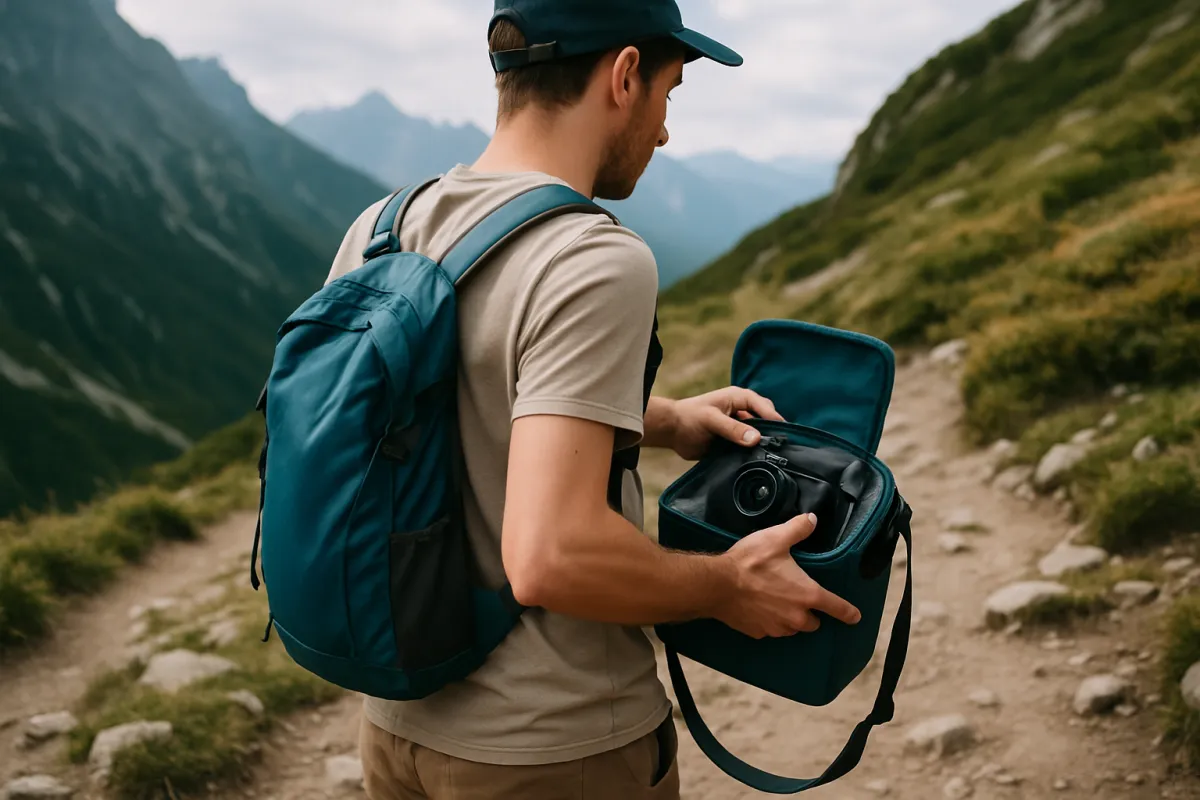
Set against that, a lightweight telephoto is with you on the hike, in the day bag, at the school game you almost skipped, and around your neck for the four hours a heavy lens would have made unbearable. For travel, family sport in daylight and casual wildlife, the light lens is not a compromise so much as the correct answer. Buy the heavy one only when you can name the specific frame, usually dim light or a small distant subject, that the light one cannot take. Our full-frame versus crop-sensor field note covers the format lever in full, and the companion above will name a focal range for what you actually shoot.
Why a fast telephoto weighs what it does
The first lever deserves its own arithmetic, because it is the one that explains the price and weight of every long lens you will ever look at, and you can do it in your head on a shop floor. The diameter of the entrance pupil, the effective opening the lens presents to incoming light, is the focal length divided by the f-number. That is not an approximation. It is the definition of the f-number, and it means a 200mm lens at f/2.8 needs an opening about 71mm across, while the same 200mm at f/5.6 needs only about 36mm.
Then geometry takes over. Area grows with the square of the diameter and the volume of a similarly shaped element grows with the cube, so doubling the opening quadruples the frontal area and roughly octuples the glass. The two stops between f/2.8 and f/5.6 on a 200mm lens are not a modest difference in the specification. They are four times the area of glass at the front of the lens, sitting at the far end of a lever arm from your hands.
| Focal length | Maximum aperture | Entrance pupil it needs | Front glass area, relative |
|---|---|---|---|
| 200mm | f/5.6 | about 36mm | 1.0x (the baseline) |
| 300mm | f/6.3 | about 48mm | about 1.8x |
| 400mm | f/6.3 | about 63mm | about 3.2x |
| 200mm | f/2.8 | about 71mm | about 4.0x |
| 300mm | f/4 | about 75mm | about 4.4x |
| 400mm | f/2.8 | about 143mm | about 16x |
The row that changes how people shop is the third one. A 400mm at f/6.3 needs a smaller clear opening, about 63mm, than a 200mm at f/2.8 needs at about 71mm. Twice the reach for less front glass, purely because the slower aperture was accepted. That single comparison is the entire reason lightweight long zooms exist, and it is why the advice to buy the shortest lens that reaches your subjects has a companion piece: buy the slowest lens your light allows, and spend the saved weight on actually carrying it.
Two honest caveats keep the arithmetic from being oversold. The physical front element is always somewhat wider than the entrance pupil, because the lens has to gather light from off-axis parts of the scene as well as the centre. And the front group is the dominant term in a long lens rather than the only one: the rest of the optical formula, the focusing mechanism, any stabilising group, the barrel and the collar all add mass on top. Use the entrance pupil to predict the shape of a lens, not to predict its exact number on a scale. Our aperture field note explains the f-number itself, and the focal length note works the same relationship from the geometry side.
Internal focusing telephoto lens versus internal zoom
Two build features get confused constantly, and the difference matters enough on a long lens to be worth separating carefully. An internal focusing telephoto lens moves a small internal group to focus, so the front of the lens neither rotates nor extends as focus changes. An internal zoom telephoto lens keeps the whole barrel at one fixed length across its entire zoom range. A lens can have either, both or neither, and the two behave quite differently in your hands.
Internal focusing earns its place for reasons that sound minor and turn out not to be. The filter thread stays still, which is the difference between a polarizer that holds its setting and one you have to reset after every focus change, a point our camera filters field note explains in more detail. A small internal group has far less mass to accelerate than a whole front assembly, so focus is faster and reverses more willingly, which is exactly what a moving subject demands. The lens does not pump air through the focus travel, so it draws in less dust. And the minimum focus distance is often shorter than an equivalent design that focuses by extension. The costs are real but narrow: internal focusing designs need more elements, so they can weigh more and cost more than a simple barrel, and they usually breathe, meaning the field of view shifts slightly as focus racks, which video shooters notice and stills shooters almost never do.
Internal zoom is a different trade. A barrel that never changes length keeps the balance constant, so a monopod, gimbal or tripod head stays trimmed from the short end to the long end and a rain cover fits at any focal length. Sealing is easier because the barrel is not breathing air with every twist of the ring. The price is mass and bulk, since the barrel has to be sized for the longest configuration all the time, and the lens is never compact in the bag. An extending zoom inverts every one of those: shorter when stowed, lighter, cheaper, but the balance moves as you zoom, some designs creep outward under their own weight when pointed down and carry a lock switch precisely for that, and the airflow is a dust route on an unsealed barrel.
Reading which one you are looking at takes ten seconds. If a listing quotes one length, the zoom is internal; if it quotes a stowed length and an extended length, it is not. If the description says the filter thread does not rotate, focusing is internal. If you shoot video, or you use a polarizer or a variable neutral density filter on the front, internal focusing is worth more to you than almost any other build feature. If you carry the lens on a strap all day and stow it in a small bag, the extending zoom is usually the lighter and cheaper answer, and the balance shift is something your hands stop noticing within a week.
Telephoto lens with optical image stabilization
Stabilization matters more on a telephoto lens than on any other kind, because a long focal length magnifies camera shake exactly as much as it magnifies the subject. A tremor that is invisible at 35mm becomes a frame-ruining blur at 400mm. What a telephoto lens with optical image stabilization actually contains is a dedicated group of elements that gyro sensors and small actuators shift sideways, fast, to hold the projected image still on the sensor while the lens itself wobbles. In-body stabilization does the same job by moving the sensor instead.
At long focal lengths the in-lens version has a structural edge, and the reason is geometry rather than brand. The correction distance needed at the sensor grows with focal length, so a sensor-shift system runs out of physical travel sooner on a long lens than a short one, while an optical group inside the lens can be designed for the focal range it serves. There is a second, quieter benefit: an in-lens system steadies the image you are looking through, which makes a distant subject easier to frame and gives the autofocus system a calmer scene to lock onto. Many bodies and lenses now cooperate, with the lens handling the pitch and yaw that dominate at long focal lengths and the body handling the rest. Our image stabilization field note works through how the two systems divide the job.
Three practical controls are worth finding before you buy. A general mode corrects on both axes, which is what you want for a still subject. A panning mode corrects on one axis only, so a deliberate horizontal sweep after a running animal is not fought by a system trying to cancel it, and on a long lens that mode is close to essential for action. And tripod behaviour differs: some systems detect the rigid mount and idle, while others need switching off, because a stabilizer hunting for shake that is not there adds blur rather than removing it. Manufacturers quote a benefit in stops, measured to a test standard with a still subject and good technique. Treat that number as a best case rather than a promise.
The cost side is small and honest. A stabilising group is extra elements plus motors and sensors, so a stabilized lens is a little heavier and a little more expensive than the same optical formula without it. On a long lens that is almost always the right trade, which is why stabilization is the one weight-adding feature this field note suggests you keep when you are otherwise cutting mass. Be clear on the limit, though: stabilization fights your shake, not the subject’s motion, so it helps enormously with a perched bird and not at all with a sprinting one, where a fast shutter speed is the only cure. For static long-lens work like the moon or a distant ridge, a tripod still beats any stabilization system, which our field note on sharp photos covers alongside the hand-holding technique that squeezes the most out of a long lens.
The shutter speed floor is the number stabilization buys back. The old reciprocal rule says keep the shutter at least as fast as one over the focal length, so 1/400 second on a 400mm lens, and on a crop body you apply it to the equivalent focal length rather than the number on the barrel: that same 400mm on a 1.5x body frames like a 600mm and wants roughly 1/600. Each stop of stabilization you genuinely trust halves that floor for a stationary subject. Nothing in the rule accounts for the subject moving, which is why sports and birds in flight are shot far faster than any of these numbers regardless of what the lens is doing.
Barrel materials, sealing and what they weigh
The materials a long lens is built from account for more of its mass than most buyers expect, and unlike the optical formula they are easy to assess by hand. Most affordable telephotos use an engineering polymer shell, often over a metal or composite inner frame, which is light, cheap to mould, and perfectly rigid enough for the loads a modest lens sees. Higher-end long lenses use magnesium alloy shells and aluminium barrels, which resist flex and impact far better and add real weight for it. Neither is a scandal. A polymer barrel on a lens that lives in a padded bag is a sensible allocation of weight; an alloy barrel on a lens that gets carried up wet hillsides is equally sensible.
The mount is worth its own look. A polymer mount saves a little weight and is entirely adequate under a small lens, but a long telephoto hanging off the front of a camera puts a genuine bending load through that joint, which is one of the reasons a lens with a tripod collar should be supported at the collar rather than at the camera body. A metal mount adds a few grams and a lot of margin. Check which one you are buying whenever the lens is heavier than the body it mounts to.
Weather sealing is a set of gaskets at the mount, around the rings and behind the switches, plus tighter tolerances everywhere. It adds a modest amount of mass and a large amount of cost, and it is worth paying for only if you actually shoot in weather that justifies it, which for most telephoto users means birds and field sport rather than travel and family events. Sealing also interacts with the zoom design, since a barrel that extends and draws air is harder to seal than one that does not.
The one lever that buys lightness without giving up aperture is the glass itself. Low-dispersion and fluorite-class elements correct colour fringing so effectively that a designer can hit the same correction with fewer and thinner elements, which cuts weight substantially. It also raises the price sharply, because those materials are difficult to grow, grind and coat. That is the honest answer to why a light, fast, long lens is expensive rather than impossible: the weight was bought back with money. Two smaller items round out the tally. A wide front element takes a wide filter and a deep hood, both of which are mass and cost you may not have planned for, and a tripod collar is itself weight that some designs let you remove when you are shooting hand-held.
How to shop for a lightweight telephoto
Everything above collapses into a short list of things to read before you spend, and each one is on the page in front of you rather than in a review. Work the list and the shortlist shrinks fast.
- Read the maximum aperture at the long end, not the short end. A lens printed as f/4 to f/6.3 is an f/6.3 lens wherever you will actually use its reach, and the short-end number is close to decoration for a telephoto buyer.
- Divide the top focal length by that long-end f-number. The result is the entrance pupil in millimetres, and it predicts bulk better than any other single figure on the page.
- Check the format the lens is built for. A crop-format telephoto on a crop body is the lightest route to a given field of view, and a full-frame lens on a crop body is carrying glass you are not using.
- Check whether the length is quoted as one number or two. One number means an internal zoom that stays balanced and heavy; two means an extending design that stows small and shifts as you zoom.
- Check whether the filter thread rotates while focusing. If it does, focusing is not internal, and a polarizer will need resetting constantly.
- Check for stabilization and for a panning mode. On a long lens both are close to essential, and the panning mode is the one buyers forget to look for.
- Weigh the whole rig, not the lens. Body, lens, collar, hood and strap is what your neck carries, and the lens figure alone flatters every combination.
That list is the specification-page read. The separate pre-purchase pass further down, on mount compatibility, minimum focus distance, filter thread size and the tripod collar, is the physical check you run once a candidate is in front of you, and the two lists are meant to be worked in that order. The final test is not a specification at all: put the candidate on your own body, hang it on the strap you actually use, and walk the shop with it for five minutes with your hands off it. Buyers reliably shop for reach and then live with weight, and the strap test is the cheapest correction available. Size the spend against your real money in the upgrade budget planner once the shortlist is down to two, and let the lighter one win any tie.
What is a super telephoto lens?
Super telephoto is the label for the long end of the category, and most photographers draw the line at 300mm or 400mm and up on a full-frame body. The boundary is a convention rather than a standard, so you will see both numbers used, and a lens that counts as super telephoto on full frame reaches even further on a smaller sensor. What matters more than where the line sits is what changes once you cross it, because a super telephoto is a different tool to live with, not merely a longer one.
Four things change at once. Size and mass climb steeply, to the point where the lens carries its own tripod collar and the camera hangs off the back of it rather than the other way around. The shutter speed you need for a clean hand-held frame climbs with the focal length, so 1/500 second becomes a floor rather than a comfort. Price rises faster than reach, because a long lens with a usable maximum aperture needs a large, precisely made front element. And the air itself becomes a limit: over long distances on a warm day, heat shimmer softens detail before the optics do, which is why super telephoto shooters favor early morning and shoot low over cool ground rather than across hot pavement.
Who genuinely needs one? Bird photographers, people shooting small or wary mammals, field sports shot from behind a fence, and anyone chasing real lunar detail. Everybody else is usually better served by a medium telephoto plus patience and fieldcraft, because getting closer is free and reach is not. If birds are the reason you are reading this, our field note on photographing birds covers the settings and approach that decide whether the reach pays off, and the companion above will show what your candidate focal length actually frames on your body.
Telephoto focal length ranges explained
The telephoto category is not one thing but a spectrum, and dividing it into three rough bands makes the whole buying decision clearer. The bands overlap at the edges and different shooters draw the lines slightly differently, but the structure holds up well as a planning tool.
Short telephoto covers roughly 70mm to 135mm. This is the gentle end of the range, long enough to magnify and compress but still compact enough to carry comfortably and hand-hold with ease. It is the home of the classic portrait focal lengths and the short end of most telephoto zooms.
Medium telephoto runs from about 135mm to 300mm. Here the reach becomes serious: you can fill the frame with a player across a field, a performer on a stage, or a deer at the edge of a meadow. Lenses in this band grow noticeably larger and heavier, and stabilization starts to matter a great deal.
Super telephoto begins around 300mm and climbs to 400mm, 500mm, 600mm and beyond. This is specialist territory for birds, distant wildlife and the moon, where subjects are small and far and every extra millimeter of reach counts. Super telephotos are big, expensive and demanding to shoot well, and most photographers arrive here only after they know exactly why they need the length. Knowing which band your subjects live in is the first and most useful step in choosing a telephoto.
The telephoto zoom ranges you will actually shop for
Bands are a way of thinking; the ranges printed on lens barrels are what you will actually be choosing between. Long lenses cluster into a handful of conventional ranges that repeat across nearly every camera system, and matching your subjects to one of them collapses a confusing shelf into a short list. The table below maps the common ranges to their class, their natural subjects and the honest trade each one asks you to accept.
| Range | Class | Best for | The trade |
|---|---|---|---|
| 70-200mm | Short to medium telephoto | Portraits, events, stage, indoor and close-court sports | Fast versions are heavy and costly; reach runs out for wildlife |
| 70-300mm | Short to medium telephoto | Travel, daylight sports, casual wildlife, one-lens reach | Variable aperture dims at the long end, so it wants good light |
| 100-400mm | Medium to long telephoto | Field sports, general wildlife, larger birds, the moon | Bulky enough to notice all day; still short for small songbirds |
| 400mm and up | Super telephoto | Small birds, skittish wildlife, distant sport, lunar detail | Heavy, expensive, and usually wants a monopod or tripod |
Read the table as a starting map rather than a set of hard borders, because the ranges blend and a versatile zoom often spans two bands at once. A 70-300mm, for instance, covers the short and medium bands in a single lens, which is exactly why it is such a popular all-purpose telephoto and why so many photographers never need a second one.
Two patterns are worth naming. First, the ranges get longer at the top but they also get slower: as the maximum focal length climbs, the maximum aperture usually narrows, so a 400mm zoom typically opens less widely than a 200mm one. Second, ranges that start further out, like a 100-400mm, are less useful as walk-around lenses because you cannot back off to a normal field of view. If your subjects span several rows, a wide-ranging zoom that touches them all is usually a smarter first purchase than a specialist prime that nails one and misses the others.
What telephoto lenses are for
Every telephoto lens exists to solve one basic problem: the subject is farther away than you can or should get. That single problem shows up across wildly different kinds of photography, which is why the telephoto is one of the most versatile categories in a camera bag despite its reputation as a specialist tool.
The obvious use is reach for subjects you cannot approach. Wildlife flees a nearing human, athletes are penned behind sidelines, and performers are locked on a stage, so the only way to fill the frame is to bring the subject closer optically. The less obvious uses are about the look rather than the distance. A short telephoto flatters a face and melts a background, which is why portrait photographers reach for one even when they could stand closer with a shorter lens.
The compressed perspective a long lens produces lets scenic shooters stack distant ridges into dramatic layers and lets sports photographers make a background loom behind an athlete. Astrophotographers use long lenses to enlarge the moon and bright celestial objects into something with visible detail. The common thread is control: a telephoto gives you command over both how close the subject appears and how the background relates to it, two things a wide lens simply cannot offer. The sections below walk each major use in turn so you can see which ones match your own shooting.

Wildlife and bird photography
Wildlife is the use case that sells the most telephoto lenses, and for good reason: no other subject punishes a lack of reach so plainly. Animals will not tolerate a close approach, birds even less so, and the difference between a frame-filling portrait of an eagle and a distant speck is entirely a question of focal length. Most wildlife photographers treat 300mm as the practical floor for larger mammals at moderate distance, with 400mm to 600mm being where small and skittish subjects like songbirds become genuinely workable.
Reach alone does not make the photograph, though, and this is where beginners often overspend on length and underspend on technique. A long lens magnifies every tremor of the hands, so a shutter speed that would be fine on a 50mm produces a soft mess on a 500mm. The old rule of thumb, using a shutter speed at least as fast as the focal length, means 1/500 second or faster on a 500mm lens before you even account for the animal moving. Apply that rule to the equivalent focal length rather than the number on the barrel, because a crop sensor magnifies the shake along with the subject: a 300mm lens on a 1.5x body frames like a 450mm and wants roughly 1/450.
Stabilization, either in the lens or the body, buys back some of that margin, and good long-lens technique buys back more, a topic our field note on taking sharp photos covers in full. Fieldcraft buys back more still: a hide, a slow approach and a subject that has stopped noticing you are worth more focal length than most upgrades. Our note on photographing birds handles that side of it, since this page is about choosing the lens rather than working the subject. A crop-sensor body is a wildlife shooter’s friend here too, turning a 300mm into a 450mm-equivalent field of view for free. Price the reach you actually need in the upgrade budget planner before chasing the longest lens on the shelf.
Sports and action
Sports photography is the second great home of the telephoto lens, and it shares wildlife’s core problem of subjects you cannot approach, with an added premium on speed. Athletes are held back by sidelines, fences and the flow of play, so a long lens is the only way to fill the frame with a face or a decisive moment. For field sports played at a distance, 300mm or 400mm is common, while court and indoor sports played closer often reward a fast 70-200mm that can freeze motion in dimmer light.
The distinctive demand of sports is that the subject moves fast and unpredictably, which raises two specs above all others. The first is autofocus performance, which lives partly in the camera body, so a serious action shooter pairs a long lens with a body that tracks moving subjects reliably. The second is maximum aperture, because a wider aperture lets you keep the shutter speed high enough to freeze motion without pushing the ISO into noisy territory, especially under stadium lights or indoors.
This is exactly why the professional sports lens is so often a fast f/2.8 telephoto zoom: it combines reach, a wide aperture and the flexibility to reframe as play develops. Most enthusiasts do not need the professional version, and a variable-aperture 70-300mm shoots daytime sports perfectly well, but understanding why the fast glass exists helps you judge whether your own shooting justifies the cost. Our field note on photographing sports walks the settings that turn that reach into keepers.
Portraits and the compression look
It surprises many beginners that some of the best portrait lenses are telephotos, but the classic portrait focal lengths of 85mm, 105mm and 135mm all sit in the short telephoto band. The reason is a combination of flattery and separation. A longer focal length subtly compresses facial features, which counteracts the mild distortion that shorter lenses introduce up close and produces a more natural, pleasing rendering of most faces. At the same time, the narrow angle of view and the shooting distance throw the background heavily out of focus, lifting the subject cleanly off whatever is behind them.
There is a working-distance benefit too. A short telephoto lets you stand a comfortable few steps back from your subject rather than looming over them, which relaxes people and produces better expressions, and it keeps the camera out of their personal space. The trade is that you need room to back up, which makes long portrait lenses awkward in cramped interiors, and it is the reason a 50mm remains a more practical everyday portrait lens for tight spaces.
If you are weighing the two most popular portrait focal lengths, our 50mm versus 85mm field note settles which to reach for first, and our guide to taking portrait photos walks the light and settings that make the focal length pay off. The short telephoto is proof that reach is not only about distant subjects; sometimes it is about how a nearby subject renders.

The moon, astrophotography, and the night sky
Point a telephoto lens at the night sky and it reveals its most dramatic party trick: the moon, which looks small and flat to the naked eye, becomes a detailed disc of craters and seas when magnified by a long lens. The moon is deceptively demanding, though. It is far brighter than the dark sky around it, so the common mistake is a blown-out white blob, cured by exposing for the lit surface rather than the black frame. Filling the frame with the lunar disc takes real reach, generally 300mm at a minimum for a satisfying size and 500mm or more for close detail, and a crop sensor helps here as much as it does for wildlife. Our seven-step note on photographing the moon covers the exposure and focus routine once you have the lens.
Beyond the moon, telephoto lenses serve a narrower but rewarding role in astrophotography, enlarging bright objects and reaching for detail that wide lenses spread too thin. The catch is that everything in the sky moves, slowly but steadily, as the earth rotates, so long exposures at long focal lengths turn pinpoint stars into trails unless you use a tracking mount.
For most people starting out, wide-angle astrophotography of the Milky Way and constellations is the easier and more forgiving entry point, which our field note on photographing the night sky walks step by step. The telephoto’s place in night photography is the moon first, then specific bright targets once you have the technique and the mount to support them.
Understanding telephoto compression
Compression is the single most misunderstood property of telephoto lenses, and understanding it turns the long lens from a reach tool into a creative one. Compression is the effect where background elements appear larger and closer to your subject than they look to the eye, so a telephoto shot of a cyclist might show a mountain looming enormous behind them, or a row of distant hills stacking into flat, overlapping layers at dawn. It is the signature telephoto look, and photographers across genres use it deliberately.
The common explanation, that the lens itself bends space, is not quite right, and the accurate version is more useful. Compression comes from the distance you shoot from, not from the glass. Because a long lens magnifies, it forces you to stand far back to frame a subject, and from that distance the relative sizes of near and far objects flatten out, since the background is not much farther from you than the subject in proportional terms. Stand close with a wide lens and the background races away tiny; stand far with a telephoto and the background stays large.
The practical lesson is that you control compression by controlling your distance and focal length together. Want a background to loom? Back up and zoom in. Want it to recede? Move closer with a shorter lens. This is the same tool a scenic shooter uses to stack ridges, covered from the other direction in our best lens for landscape photography note, and the same one a portrait shooter uses to enlarge a setting sun behind a subject. It is available to you the moment you understand where it comes from.
Prime vs zoom telephoto lenses
The prime-versus-zoom question runs through the whole lens world, and it takes a particular shape in telephoto territory. A telephoto prime has one fixed focal length, say 300mm, while a telephoto zoom covers a range, say 70-200mm or 100-400mm, that you dial in with a ring. For most photographers buying their first long lens, the zoom is the right answer, and the reason is the same one that makes zooms so useful generally: distant subjects move and rarely sit at the one distance a prime is built for.
It is worth separating two words that get used as if they were the same. Telephoto describes reach; zoom describes whether that reach is adjustable. A 300mm prime is a telephoto that does not zoom, a kit 18-55mm is a zoom that never reaches telephoto, and a 70-200mm is both at once. When you shop, read the focal range first to learn how much reach a lens gives you, then read whether the range is fixed or variable to learn how much reframing it allows.
A telephoto zoom lets you reframe from a whole scene to a tight detail without swapping lenses or missing the moment, which is exactly what wildlife and sports demand. A 70-200mm or 70-300mm covers the enormous majority of everyday telephoto needs in a single, manageable package. Telephoto primes earn their place at the top of the market, where fast fixed long lenses deliver wider maximum apertures and outright sharpness that professionals depend on, at prices and weights that rival a used car. Our full prime versus zoom lens field note walks the general trade in depth, and its conclusion holds cleanly for telephotos: buy the zoom first, and consider the fast prime only once you know precisely why you need it.
Aperture on a telephoto lens
Aperture matters on a telephoto lens, but it behaves differently than it does on the fast primes people obsess over. Most affordable telephoto zooms have a variable maximum aperture, printed as something like f/4 to 6.3, which means the lens opens to f/4 at its short end and closes to f/6.3 as you zoom to its longest reach. That is dimmer than a standard lens, and it is a direct consequence of the physics of long focal lengths: a wide aperture on a long lens requires a physically enormous front element, which is why fast telephotos are so large and expensive. The section above on why a fast telephoto weighs what it does works that relationship out in millimetres. If f-stops themselves are still shaky ground, our note on aperture sets the foundation.
The consequence for your shooting is that variable-aperture telephotos want good light. In daylight they are excellent, but as the sun drops or you move indoors, the narrow aperture forces either a slower shutter speed, which risks blur from your own shake and the subject’s motion, or a higher ISO, which adds noise.
This is why the professional f/2.8 telephoto zoom exists and why it costs what it does: the constant wide aperture keeps shutter speeds high in dim conditions, which is decisive for indoor sports and dusk wildlife. For most enthusiasts shooting in good light, a variable-aperture zoom is entirely sufficient, and the money saved is better spent elsewhere. If low light is a real part of your telephoto shooting, our best lens for low light field note frames the aperture math that decides whether the fast glass is worth it for you.
Autofocus on a telephoto lens
Autofocus deserves its own heading on a long lens, because the same system that feels instant on a 35mm can feel hesitant at 400mm. Two things make focusing harder as focal length grows. Depth of field shrinks, so the margin between sharp and soft narrows to a sliver and a small focusing error becomes visible. And the narrow angle of view means the lens has less of the scene to work with, so a moment of lost tracking leaves it hunting through a long focus range with nothing recognizable in the frame.
The features that matter are less glamorous than maximum aperture but often decide more frames. A focus limiter switch, which restricts the lens to the near or far half of its range, stops the long hunt that costs you the shot. A quiet, direct-drive focus motor moves faster and reverses more willingly than an older screw-driven design. Full-time manual override lets you nudge focus without leaving autofocus. And the maximum aperture matters here again for a second reason: autofocus systems need light to see contrast, so a dim lens at dusk, or a lens stopped down further by a teleconverter, can slow or stall focus entirely.
Match the expectation to the subject. A perched bird or a stationary player forgives a modest autofocus system completely. A bird in flight or a sprinting athlete does not, and that is the case where a serious body plus a lens designed for tracking earns its price. Be honest about which of those you shoot most often, because paying for tracking you never use is one of the quieter ways to waste a telephoto budget.
Handling a long lens: support, balance, and strain
Specification sheets rarely capture the thing that most determines whether you enjoy a telephoto: how it behaves in your hands over a real day of shooting. Long lenses shift the balance of a camera forward, sometimes far enough that the body becomes a handle hanging off the back. That changes how you hold it, how you carry it and how quickly your arms tire, and none of it shows up in a spec list.
Support is the first adjustment. Once a lens carries a tripod collar, mount the tripod or monopod to the collar rather than to the camera body, because supporting the heavy end keeps the mount from taking a bending load. A monopod is the underrated tool of long-lens work: it takes almost all the weight, sets up in seconds and still lets you swing with a moving subject, which a tripod head fights. For static work at the long end, a proper tripod remains best, and our note on choosing a tripod covers matching one to the weight you are putting on it.
Carrying is the second. A thin neck strap under a heavy telephoto is a genuinely unpleasant way to spend a day; a wide strap, a sling that carries the load on one shoulder, or a harness that spreads it across both makes a large difference. Support the lens barrel with your left hand from underneath rather than gripping the camera body, tuck your elbows into your ribs, and let your skeleton rather than your muscles hold the weight.
The honest summary is that photographers consistently overestimate the reach they need and underestimate the weight they will carry, then find the monster lens living in a closet while a light zoom does the real work. Handle a telephoto before you buy it, imagine a full day with it on a strap, and be truthful about whether you will bring it. For many buyers, handling is not a footnote on a telephoto purchase; it is the deciding spec.
Teleconverters: more reach and its cost
A teleconverter is a small optical accessory that mounts between the camera body and a telephoto lens and multiplies its focal length, typically by 1.4x or 2x. It is the cheapest way to buy reach: a 1.4x converter turns a 300mm lens into a 420mm, and a 2x turns it into a 600mm, for far less money and weight than a longer lens would cost. For wildlife shooters wishing for more length on a budget, that sounds like a free lunch, and it is genuinely useful, but it is not free.
Every teleconverter costs you light and a little sharpness. A 1.4x converter reduces the maximum aperture by one stop, so an f/4 lens becomes an effective f/5.6, and a 2x converter costs two stops, turning that f/4 into f/8. That lost light can push autofocus and shutter speed into difficult territory, and some cameras struggle to focus at all past a certain effective aperture.
There is also a modest hit to image quality, usually small with a good converter matched to a good lens and larger with cheap combinations. Compatibility is worth checking before you buy, since converters are usually designed for a specific family of lenses and will not mount on, or will not perform on, everything. The honest verdict: a teleconverter is an excellent tool when you already own a quality, reasonably fast telephoto and need occasional extra reach in good light, and a poor substitute for the right lens when you are trying to rescue a slow, cheap zoom.
Crop-sensor reach: the extra length for free
One of the most useful facts for anyone buying a telephoto is that the size of your camera’s sensor changes how much reach a given lens delivers. A smaller sensor captures a tighter slice of the image a lens projects, so the subject fills more of the frame from the same distance, which behaves exactly like extra focal length. This is described by the crop factor: an APS-C sensor has a crop factor of about 1.5, some APS-C sensors from one maker are slightly smaller at about 1.6, and a Micro Four Thirds sensor has a factor of 2. The 1.5 against 1.6 difference is small enough to ignore when you are shopping.
The math is simple and powerful. A 300mm lens on an APS-C body frames like a 450mm on full frame (300 multiplied by 1.5), and the same lens on a Micro Four Thirds body frames like a 600mm (300 multiplied by 2). For wildlife and sports shooters who are perpetually wishing for more length, that free reach is a genuine advantage, and it is a major reason many long-lens photographers deliberately choose smaller-sensor systems.
The trade is real but modest: a smaller sensor gathers less light overall and can show more noise in dim conditions, so the extra reach comes with a slight low-light penalty rather than being entirely free. Our full-frame versus crop-sensor field note walks the full comparison, but for the telephoto buyer the headline is clear: if reach is your priority, a crop-sensor body stretches every lens you own, and it should factor into which system you build around. Run your own focal length and sensor through the companion above to see the effective reach you would actually get.
How the telephoto classes compare on reach and portability
The core trade-off in choosing a telephoto is reach against portability, and the two move in opposite directions: the longer the lens reaches, the heavier and bulkier it gets. Scoring the three bands on each attribute out of ten makes the shape of that trade impossible to miss.
Reach versus portability by telephoto class
A typical lens in each band, scored out of ten on reach and on how easy it is to carry and hand-hold. Illustrative.
Reach and portability trade off almost perfectly: the super telephoto that reaches farthest is the hardest to carry, while the short telephoto that carries easily reaches the least. Buy the shortest lens that reaches your real subjects.
Read the chart as a matching exercise, not a scoreboard to total. If your subjects are close enough that a short telephoto reaches them, you gain nothing and lose plenty by carrying a super telephoto. If your subjects are genuinely distant, the reach is worth the weight, but only if you will actually carry the lens. The photographers happiest with their telephoto are almost always the ones who bought the shortest lens that reaches their real subjects, not the longest lens their budget allowed.
What a wide-range telephoto zoom covers
A single wide-range telephoto zoom, like a 70-300mm, earns its popularity by covering multiple bands in one lens, and it is worth seeing how a real shooting year tends to distribute across that range. The split below is illustrative, but it reflects a common pattern: most frames land in the middle of the range, with the extreme long end used less often than buyers expect.
Where the frames land across a 70-300mm zoom
Illustrative share of a typical enthusiast's telephoto shots by section of the zoom range over a year.
Most telephoto frames land in the middle of the range, not at the extreme long end. That is why a versatile zoom often serves better than a specialist prime, and why buyers should not overpay for reach they will rarely use.
The lesson buried in that split is that reach past 300mm, which is the thing beginners most often crave, accounts for a smaller share of real shooting than the excitement suggests. A wide-range zoom that spends most of its life in the middle band answers the bulk of everyday telephoto photography, which is a strong argument for starting there and adding specialist length only once you have proven you need it. Match the range to where your frames will actually land, not where you imagine they might.
How to choose a telephoto lens by subject
The cleanest way to choose a telephoto is to start from your subject and work backward to the focal length, because the subject sets the reach and the reach sets nearly everything else. Run through the main cases and your requirements fall out quickly.
If you shoot portraits, you want a short telephoto in the 85mm to 135mm range, prioritizing a wide aperture for background separation over any extra reach. If you shoot field sports or general wildlife, you want a medium-to-long telephoto reaching 300mm or so, prioritizing autofocus speed and a fast enough aperture for the light you shoot in. If you shoot birds or small, distant, skittish wildlife, you want genuine super telephoto reach of 400mm and up, and you should factor a crop-sensor body into the plan to stretch that length further.
If you shoot the moon or bright celestial objects, you want 300mm at a minimum and a tripod to hold it steady. And if you want one telephoto for travel and general use, a 70-300mm zoom that spans portraits through moderate reach is almost always the right answer. The mistake to avoid is buying more length than your subjects demand, because that length always costs money, weight and convenience. Find your subject, read off the reach, and let it anchor the decision. The companion above will name a focal range for the subject you pick and show the effective reach on your specific camera body.
How to choose by budget
Subject sets the focal length you want; budget sets the version of it you can sensibly buy, and the good news is that the telephoto market offers a genuinely capable option at almost every price. Being honest about your budget prevents both overspending on reach you will not use and underspending on a lens too slow or soft to satisfy.
At the entry level, a variable-aperture telephoto zoom like a 70-300mm is the workhorse, and used copies represent some of the best value in all of photography, typically at a fraction of what the same lens costs new. This lens covers portraits, daylight sports, travel and casual wildlife, and it is the right first telephoto for the large majority of buyers. In the mid range, a faster or longer zoom, or a fast short telephoto prime, adds low-light capability and reach for a meaningful step up in price. At the top, professional f/2.8 zooms and fixed super telephoto primes deliver the aperture, reach and autofocus that demanding sports and wildlife work require, at prices an order of magnitude above an entry-level zoom.
The sensible path for most people is to start with a quality used variable-aperture zoom, learn exactly what you wish it did better, and let that specific wish, more reach, more aperture or faster focus, direct the next purchase. Sequence the plan against your real money in the upgrade budget planner, and read our what to upgrade first field note before assuming the telephoto is even the right next buy. If you are still shooting the lens the camera came with, our kit lens versus prime comparison is worth a look first. And if the real bottleneck turns out to be autofocus tracking rather than reach, that is body territory, and our note on when a new camera is actually justified covers that call.
Common telephoto lens mistakes
A few predictable errors trip up nearly every first-time telephoto buyer, and naming them is the cheapest way to avoid them.
- Buying more reach than the subjects need. The most common waste: a super telephoto bought for occasional use that lives in the closet because it is too heavy to carry, while a lighter zoom does the real work. Buy the shortest lens that reaches your actual subjects.
- Ignoring shutter speed at long focal lengths. A long lens magnifies shake, so the shutter speed that was fine on a standard lens produces soft frames on a telephoto. Keep the shutter at least as fast as the equivalent focal length, which on a crop body means the barrel number times the crop factor, and faster still for moving subjects.
- Overlooking stabilization. On a long lens, stabilization is close to essential for hand-held shooting, not a luxury, and skipping it to save money often means missed shots.
- Treating light weight as a free lunch. A light telephoto is the right buy for many people, but it is light because it is slower, and pretending otherwise leads to disappointment at dusk. Know what you traded away.
- Expecting a cheap teleconverter to rescue a slow zoom. Converters cost light and sharpness, and pairing one with a slow, budget lens usually disappoints. Match a converter to a lens that deserves it, and use it in good light.
- Forgetting the crop-factor math. Buyers on crop-sensor bodies sometimes buy more focal length than they need, forgetting that the sensor already stretches their reach. Do the equivalence math before ordering.
Every one of these mistakes shares a root cause: buying the number on the box instead of the lens that fits your real shooting. The sections above are the antidote, and they are far cheaper than the errors.
The used telephoto market
The used market deserves a section of its own, because telephoto lenses are one of the best places in photography to buy secondhand and save real money without giving up much. Lenses hold their optical quality for decades when cared for, and a telephoto zoom bought used often costs a fraction of its price new while performing identically. For a category where the new prices climb steeply, that discount is the difference between owning a good telephoto and going without.
A few sensible checks keep a used purchase safe. Inspect the front and rear elements for scratches and fungus, work the zoom and focus rings to confirm they move smoothly, and test the autofocus and any stabilization if you can before buying. Cosmetic wear on the barrel rarely affects images, so a scuffed lens at a lower price is often the smart buy, while internal haze or fungus is a reason to walk away.
Older telephoto zooms in particular represent tremendous value, because reach and optical quality have not changed as dramatically as autofocus and stabilization have, so a previous-generation lens frequently delivers the shot for far less. Buying used is also the low-risk way to try a focal length before committing, since a used lens bought sensibly can usually be resold for close to what you paid. Borrow or rent before buying if you can, because an afternoon with a long lens on your own body answers questions no specification sheet will. For most enthusiasts, the used telephoto is not a compromise but the smart default.
A worked example: choosing your first telephoto
Theory into practice: one illustrative $500 budget and one common shooter, to show how the decision resolves. Our shooter photographs her kids’ weekend soccer games and takes casual wildlife shots on family hikes, using an APS-C camera with the kit zoom that stops at 55mm, far too short to reach the field or the far tree line.
Her subjects set the focal length first. Field sports and general wildlife point to the medium-to-long telephoto band, roughly 200mm to 300mm, and because she shoots outdoors in daylight, she does not need an expensive fast aperture. Her APS-C body helps her reach, since a 300mm lens will frame like a 450mm on full frame, which is ample for a soccer field and workable for wildlife at moderate distance.
Her budget points straight at the used variable-aperture 70-300mm zoom, the category workhorse, available secondhand within her illustrative $500. Weight matters to her too, since the lens has to survive a hike as well as a touchline, and the variable-aperture zoom is the lighter option by a wide margin. She checks the glass and rings, confirms the stabilization works, and buys it.
The result covers her whole use case in one lens: 70mm for a portrait of her kid before the game, 200mm for the action, and 300mm reaching 450mm-equivalent for the deer on the trail home. She has bought the shortest lens that reaches her real subjects, in daylight, on the sensor that stretches it further, for the least money, which is exactly the decision this field note recommends. Run your own subject, sensor and budget through the companion above and the answer will shift to fit what you actually shoot.
What to check before you buy a telephoto
Once you have a shortlist, a short pre-purchase pass catches the problems that show up later. Run these checks on any candidate, new or used.
- Mount and format. Confirm the lens exists for your camera’s mount, and check whether it is designed for full frame or for a crop sensor, because a crop-only lens on a full-frame body will vignette or force a crop mode.
- Real focal range against your subjects. Multiply the focal length by your crop factor and compare it to what you need to frame. The companion above does this arithmetic for you.
- Weight in your hands, not on the page. Hold it on your own body if you possibly can. A number in grams tells you much less than five minutes with the thing on a strap.
- Stabilization, and whether it duplicates your body. If your camera already stabilizes, lens stabilization still helps at long focal lengths, but it matters far more on a body without it.
- Minimum focus distance. Long lenses often cannot focus close, which is a surprise the first time a subject walks toward you and the lens gives up.
- Filter thread size. Big front elements take big, expensive filters, and it is worth knowing that before you plan a filter kit around the lens.
- Tripod collar and support. Above a certain size, a collar is not optional if you plan to use a tripod or monopod. Check whether it is included or sold separately.
None of these checks require expertise, and each of them prevents a specific, common regret. Work the list before the money moves rather than after.
The bottom line
A telephoto lens is the reach in your bag, the tool that pulls a distant subject close and stamps it with the flattened, compressed look that no shorter lens can produce. The category is best understood as three bands: short telephotos from 70 to 135mm for portraits and gentle compression, medium telephotos from 135 to 300mm for sports and general reach, and super telephotos of 300mm and up for birds, distant wildlife and the moon. For the large majority of buyers, a quality telephoto zoom, ideally a used variable-aperture 70-300mm, is the right first purchase, because most telephoto frames land in the middle of the range and the flexibility to reframe matters more than the last stop of aperture. Choose by subject first and budget second, respect the shutter speed and stabilization that long lenses demand, remember that a crop sensor stretches every millimeter of reach, and be honest about weight, because a lighter telephoto you carry everywhere beats a longer one you leave at home. Price the plan per session in the upgrade budget planner, match the focal length to what you actually shoot, and the telephoto stops being an intimidating specialist tool and becomes the most rewarding reach you own.
Written as a teaching page rather than a shopping cart. No manufacturer paid for a mention and none is named, deliberately, because the right telephoto depends on your subjects and your mount rather than on a badge. Dollar figures here are illustrative planning numbers only; street prices move with system, condition and the used market, and a figure that fits one week will miss the next. Focal lengths, apertures and crop factors also differ by camera system, so check which long lenses genuinely exist for your mount and how your sensor’s crop factor changes the framing before committing. When the spend is large enough to matter, treat this as the starting point for your own research and put your hands on the lens first.
Frequently asked questions
What is a telephoto lens?
A telephoto lens is a lens with a long focal length that magnifies distant subjects and narrows the angle of view, so a faraway bird or player fills the frame without you walking closer. In practical terms it is any lens longer than a standard 50mm, and most photographers reserve the word for lenses from about 70mm upward. The long focal length also compresses depth, stacking foreground and background closer together than the eye sees them. Telephoto lenses come as both fixed primes and zooms, and they are used for wildlife, sports, stage work, portraits and the moon, anywhere the subject is farther away than you can walk.
What focal length is considered telephoto?
The common dividing line is 70mm on a full-frame body, where a lens starts to noticeably magnify rather than simply record what is in front of it. From there the range splits into three rough bands: short telephoto from about 70mm to 135mm, medium telephoto from 135mm to 300mm, and super-telephoto at 300mm and above. Each band suits different subjects, with short teles favoring portraits and long ones reaching for wildlife. On a crop-sensor camera these numbers reach even further, because the smaller sensor tightens the effective field of view.
What is a super telephoto lens?
A super telephoto lens is the long end of the category, and most photographers draw the line at 300mm or 400mm and up on a full-frame body. What changes at that length is not only reach: the lens grows large enough to want its own tripod collar, the minimum shutter speed for a hand-held frame climbs past 1/500 second, the price curve turns steep, and heat shimmer in the air between you and the subject starts limiting detail more than the glass does. Super telephotos exist for small, distant, unapproachable subjects, chiefly birds, skittish wildlife, field sports and the moon. If your subjects are none of those, a shorter lens will serve you better and you will carry it more.
What is a lightweight telephoto lens?
A lightweight telephoto is one that trades maximum aperture, and usually a little reach, for a size you will actually carry. Five levers make a long lens light: a narrower maximum aperture instead of a constant fast one, a modest top focal length rather than super telephoto reach, a smaller sensor format, an engineering-plastic barrel rather than an alloy one, and an extending zoom rather than an internal one. The trade is real. A lighter telephoto gathers less light, so it wants daylight or a higher ISO, its autofocus has less contrast to work with at dusk, and the build flexes more. For travel, hikes and daytime sports that trade is often the right one, because the best telephoto is the one that leaves the house with you.
Do I need a telephoto lens for wildlife?
For serious wildlife and birds, a telephoto is not optional, because wild animals will not let a photographer approach close enough for a shorter lens to fill the frame. Most wildlife shooters treat 300mm as a practical starting point and 400mm to 600mm as the range where small and distant subjects become workable. A crop-sensor body stretches these numbers usefully, so a 300mm lens on an APS-C camera frames like a 450mm on full frame. Reach is only half the job, though: a long lens also demands stabilization, fast shutter speeds, and steady technique to turn magnification into sharp frames.
What is lens compression on a telephoto?
Compression is the visual effect where a long focal length makes background elements look larger and closer to the subject than they appear to the eye. It is why a telephoto shot of a runner can show mountains looming huge behind them, or why distant hills stack into flat layers at dawn. The effect comes from the shooting distance the long lens forces you into, not from the glass magically bending space, but the practical result is the same signature look. Portrait, sports and scenic photographers all use compression deliberately to control how a background relates to the subject.
Is a telephoto lens good for portraits?
A short telephoto is one of the best portrait tools there is, which is why the classic portrait focal lengths of 85mm, 105mm, and 135mm all sit in telephoto territory. The longer focal length compresses features slightly, which flatters most faces, and it throws the background well out of focus for clean subject separation. It also lets you stand a comfortable distance from the subject rather than crowding them, which relaxes people and improves expressions. The catch is that you need room to back up, so a short telephoto is awkward in a cramped interior where a 50mm still works.
Prime or zoom telephoto: which should I buy?
Most people are better served by a telephoto zoom first, because the ability to reframe from a whole scene to a tight detail without swapping lenses matters enormously when subjects move. A 70-200mm or 70-300mm zoom covers the majority of everyday telephoto needs in one body. Note that telephoto and zoom are separate ideas: telephoto describes reach, zoom describes whether that reach is adjustable, so a 300mm prime is a telephoto that does not zoom and a kit 18-55mm is a zoom that never reaches telephoto. Telephoto primes win on maximum aperture and outright sharpness, which is why sports and wildlife professionals carry fast fixed long lenses, but a quality zoom delivers most of the capability for far less money and weight.
Does a crop sensor give more telephoto reach?
A crop sensor gives more effective reach in the sense that it captures a tighter slice of the scene, so the subject fills more of the frame from the same distance. An APS-C body with a 1.5x crop factor makes a 300mm lens frame like a 450mm on full frame, and a Micro Four Thirds body with a 2x factor makes it frame like a 600mm. This is a genuine advantage for wildlife and sports shooters who are always wishing for more length. The trade is that the smaller sensor gathers less light and can show more noise in dim conditions, so the extra reach is not entirely free.
What is an internal focusing telephoto lens?
An internal focusing telephoto lens moves a small group of elements inside the barrel to focus, so the front of the lens neither rotates nor extends. Three things follow from that. A polarizer or a graduated filter keeps its setting, because the filter thread does not turn. Focus is quicker and reverses more willingly, because a light internal group has far less mass to accelerate than a whole front assembly. And the lens draws in less dust, because it is not pumping air through its focus travel. The costs are narrow: internal focusing designs use more elements, so they can weigh and cost a little more, and they usually breathe, meaning the framing shifts very slightly as focus racks. Note that internal focusing is a separate feature from an internal zoom, which is a barrel that stays one fixed length across the whole zoom range.
Do I need optical image stabilization on a telephoto lens?
On a long lens, treat stabilization as close to essential rather than a luxury, because a long focal length magnifies your own shake exactly as much as it magnifies the subject. A telephoto lens with optical image stabilization carries a group of elements that actuators shift sideways to hold the image still on the sensor, and at long focal lengths that in-lens approach has an edge over sensor-shift stabilization, since the correction distance needed at the sensor grows with focal length. Look for a panning mode, which corrects one axis only so a deliberate sweep after a moving subject is not fought. Be clear on the limit: stabilization fights your shake, not the subject motion, so it helps with a perched bird and not with a sprinting one.
Why can a longer telephoto lens weigh less than a shorter one?
Because the front glass is sized by the entrance pupil, which is the focal length divided by the f-number, not by the focal length alone. A 400mm lens at f/6.3 needs an opening about 63mm across, while a 200mm lens at f/2.8 needs about 71mm. Twice the reach, less clear aperture, and so much less glass at the heavy end of the barrel. Area grows with the square of that diameter and the volume of a similarly shaped element with the cube, which is why the two stops between f/2.8 and f/5.6 on a 200mm lens amount to four times the frontal glass area. Accepting a narrower maximum aperture is the single most effective way to buy reach without buying weight, and the price is light gathering and background separation.