What's on this page
- What Micro Four Thirds actually is
- The sensor size behind the format
- The 2x crop factor explained
- Equivalent focal length on Micro Four Thirds
- The pros: small, light, and affordable
- The reach advantage for wildlife and sports
- Deeper depth of field, for better or worse
- The cons: low light and noise
- Less background blur than bigger sensors
- Micro Four Thirds vs APS-C vs full frame
- Who Micro Four Thirds suits best
- Micro Four Thirds for travel photography
- Micro Four Thirds for wildlife photography
- Micro Four Thirds for video
- The lens ecosystem you are joining
- In-body stabilization and computational features
- Where the format struggles
- Is Micro Four Thirds dying? The honest read
- How to decide if Micro Four Thirds is for you
- Common myths about Micro Four Thirds
- The bottom line
Short answer: Micro Four Thirds is a mirrorless camera format built around a 17.3 by 13 mm sensor with a 2x crop factor, shared by OM System (formerly Olympus) and Panasonic on a single lens mount, so a 25mm lens frames like a 50mm. It trades some low light headroom and easy background blur for the smallest and lightest interchangeable lens system, the deepest telephoto reach per dollar, and a mature shared lens catalogue.
Micro Four Thirds is a mirrorless camera format built around a sensor that measures 17.3 by 13 mm and carries a 2x crop factor, shared by OM System (formerly Olympus) and Panasonic on a single lens mount. If you have been comparing cameras and kept bumping into the name without a clear explanation of what it means or whether it is right for you, this field note is the plain-language version: what the format actually is, what its small sensor genuinely buys and costs, and which photographers it serves best.
The short story is that Micro Four Thirds is a deliberate trade. It gives up some low-light performance and some easy background blur, and in return it hands you the smallest and lightest interchangeable-lens system you can buy, the deepest telephoto reach per dollar, and a mature shared catalogue of lenses. This article sizes each side of that trade honestly, sets the format next to APS-C and full frame at a glance, and helps you decide from your own subjects rather than from spec-sheet prestige. Plan the whole kit with our upgrade budget planner before anything goes in the cart, and read this alongside our full-frame versus crop field note, which frames the same sensor-size trade-off from the other end of the range.
Key takeaways
- Micro Four Thirds uses a 17.3 by 13 mm sensor, about a quarter the area of full frame, with a fixed 2x crop factor: a 25mm lens frames like a 50mm.
- It is a shared mount standard, so OM System (Olympus) and Panasonic bodies and lenses generally work together, which keeps the lens catalogue deep and the used market cheap.
- The wins are real: the smallest and lightest system, the longest telephoto reach per dollar, deep depth of field, and strong in-body stabilization.
- The costs are also real: less low-light headroom (commonly a stop or two behind full frame) and less easy background blur for a given framing.
- It suits travel, wildlife, and video shooters especially well. Match the format to your subjects, and it is an obvious pick rather than a compromise.
What Micro Four Thirds actually is
Micro Four Thirds, often shortened to MFT or M43, is an open camera-system standard that defines a specific sensor size and a specific lens mount. Introduced in 2008 as a mirrorless evolution of the earlier Four Thirds DSLR system, it removed the reflex mirror box, which let the bodies and lenses shrink dramatically while keeping interchangeable lenses and a full set of manual controls. The defining number is the sensor: 17.3 by 13 mm, with a 2x crop factor relative to full frame.
The other defining feature is that it is shared. Rather than each brand building a private, incompatible mount, Micro Four Thirds was designed from the start as a standard that multiple manufacturers could build to, and the two pillars have long been Olympus (whose camera line now trades as OM System) and Panasonic. Because they build to the same mount and communication protocol, a Panasonic lens generally works on an OM System body and the reverse, which is unusual and valuable. That openness is why the lens catalogue is one of the largest and most varied in mirrorless, and why the used market is generous enough that a strong system can be assembled for far less than a comparable full-frame kit. The format is, in short, a philosophy as much as a sensor: keep the system small, keep it open, and make the trade-offs that portability demands.
The sensor size behind the format
Everything about the format flows from one measurement, so it is worth sitting with. A Micro Four Thirds sensor is 17.3 by 13 mm. A full-frame sensor, which matches the old 35mm film frame, is about 36 by 24 mm. Line them up and the MFT sensor is roughly half as wide and half as tall, which means its total light-collecting surface is about a quarter of full frame’s. Against an APS-C sensor (around 23.5 by 15.6 mm) the MFT sensor is smaller again, though the gap is narrower.
Surface area is the number that matters, because a sensor is essentially a bucket for light, and a bigger bucket catches more of it at the same settings. That is not a quality verdict, it is a physical fact with predictable consequences: less total light gathered tends to mean noise appears a little sooner as ISO rises, and a smaller sensor renders more depth of field at a given aperture and framing. Both of those consequences are covered in their own sections below. What the small sensor is not is a lower-resolution or lower-quality part in any general sense: modern Micro Four Thirds sensors resolve plenty of detail for prints and screens, carry good color and dynamic range in decent light, and sit in bodies with current autofocus and processing. The sensor is small on purpose, and the whole system is built to cash that smallness as portability, reach, and cost. Our camera settings reference lists the sensor dimensions and crop factors side by side if you want the raw numbers in one table.
The 2x crop factor explained
Crop factor is the single most useful number to understand before you buy into any smaller-sensor format, and for Micro Four Thirds it is a clean 2x. It describes how much smaller the sensor is than full frame on each axis, and it tells you the effective field of view any lens will give. The rule is simple: multiply the lens focal length by two to get the full-frame-equivalent framing. A 25mm lens frames like a 50mm, a 12mm frames like a 24mm wide angle, and a 300mm frames like a 600mm super-telephoto.
The important thing to hold onto is that the lens itself does not physically change: a 25mm lens is a 25mm lens on any camera, with the same optical behavior. What changes is how much of the lens’s projected image the smaller sensor records, and a smaller sensor sees a tighter slice, which is why the effective view is narrower. That 2x figure is not an approximation or a marketing rounding; it follows directly from the sensor dimensions and is stable across every Micro Four Thirds body ever made. Whether the crop is a gift or a tax depends entirely on which end of the range you shoot, which the next few sections work through. For the full explanation of how crop factor behaves across all sensor sizes, our full-frame versus crop field note walks the general case.
Equivalent focal length on Micro Four Thirds
Because the crop factor is exactly two, converting between Micro Four Thirds focal lengths and the full-frame numbers most photographers think in is easy, and doing it fluently saves real money and confusion when buying lenses. The workflow is: take the equivalent framing you want in full-frame terms, halve it, and that is the Micro Four Thirds lens to look for. Want a classic 50mm standard look? Buy a 25mm. Want an 85mm portrait length? Buy a 42.5mm, a focal length that exists on the format precisely because of this math. Want a 24mm landscape wide? Buy a 12mm.
This is also where a subtler point lives, and it is one the format’s critics and defenders both misuse, so it is worth stating carefully. Focal length and field of view scale by the crop factor, cleanly and definitionally. Depth of field and total light gathering also scale in a related way, which is why a fast Micro Four Thirds lens gives less background blur and gathers less total light for a given framing than the same equivalent lens on full frame would. But the f-number for exposure brightness does not change with sensor size: an f/1.8 lens meters as f/1.8 on any camera. The clean mental model is that the crop factor tells you two things at once, the equivalent framing and the equivalent depth-of-field and light-gathering behavior, while the aperture you set for brightness stays exactly what the lens says. Keep those separate and the format stops being confusing. The companion above will convert any Micro Four Thirds focal length and aperture to its full-frame equivalents as you read.
The pros: small, light, and affordable
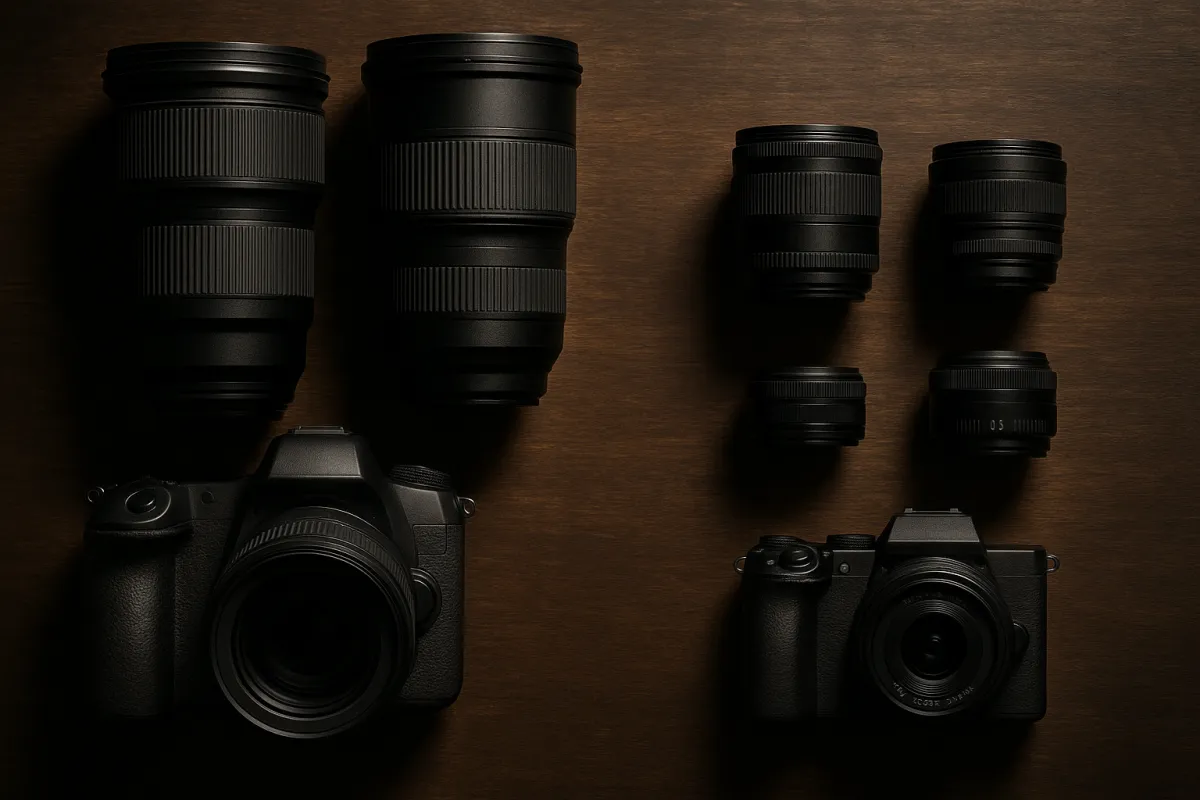
The reason the format exists is portability, and it delivers. A Micro Four Thirds body is small, but the real advantage compounds in the lenses: because they project onto a smaller sensor, they can be built smaller and lighter for the same equivalent reach, and a full travel kit of a body plus two or three lenses genuinely fits in a bag you will actually carry all day. This is not a marginal convenience. The best camera is the one you have with you, and system weight is the single biggest predictor of whether the camera comes along at all, a point our field note on upgrading keeps returning to. Moving into or out of the format is a system change rather than a body swap, and our note on switching systems when you upgrade your camera weighs exactly that trade.
Typical travel-kit weight by format
Body plus a standard zoom and a telephoto, mid-tier choices, carried all day. Illustrative.
Weight compounds in the lenses, not the body, which is where the format's portability advantage actually lives. Figures are illustrative planning numbers, not measurements of any specific kit.
Where a Micro Four Thirds system dollar goes
Approximate split of a three-year enthusiast kit spend. Illustrative.
As with any format, glass is the majority of the spend, so the money saved on smaller, cheaper lenses is the real budget win, not the body price. Illustrative shares, not a survey.
Cost follows size for the same reason. Smaller lenses use less glass and less metal, so tier for tier they cost less, and the format’s long history means the used market is deep and cheap. A capable Micro Four Thirds system, body plus a versatile lens set, can be assembled for well under what a comparable full-frame kit costs, and much of the saving lives in the glass, which is where the real money in any system goes. For a shooter on a budget who wants a complete, excellent kit rather than a stretched, partial one, that math is decisive, and it frees money for the lenses and light that improve photographs more than any sensor does.
The reach advantage for wildlife and sports
The 2x crop factor is a plain gift at the long end, and it is the single most underrated reason to choose the format. Because every focal length doubles in equivalent framing, a compact 300mm lens reaches like a 600mm super-telephoto on full frame, and it does so at a fraction of the size, weight, and price that a genuine 600mm full-frame lens would demand. Long, fast telephoto lenses are the most expensive objects in photography, so squeezing more reach from every dollar and every gram is exactly what wildlife, bird, and sports shooters need most.
This is why Micro Four Thirds is not the budget compromise in the wildlife world but often the strategic choice. A birder can carry a lens that reaches to 600mm or 800mm equivalent in a bag they can hike with, hand-hold with the help of strong stabilization, and afford without a second mortgage. The deep depth of field the smaller sensor gives, discussed below, also helps keep more of a moving animal in focus at a given aperture. The trade is the low-light behavior, since wildlife often happens at dawn and dusk, so the honest move is to pair the reach with the fastest telephoto you can justify and lean on stabilization for static subjects. But for photographers whose subjects are far away, the reach advantage is real, measurable, and frequently the deciding factor.
Deeper depth of field, for better or worse
Here is one of the format’s most misunderstood traits, and whether it reads as a pro or a con depends entirely on what you shoot. For the same framing and aperture, a smaller sensor renders more depth of field, meaning more of the scene falls within acceptable focus. Put plainly, a Micro Four Thirds image at f/2.8 shows roughly the depth of field a full-frame image would show around f/5.6 at the same framing. More of the picture is sharp, front to back, at a given aperture.
For a great deal of photography, that is a feature and not a bug. Landscape shooters chasing front-to-back sharpness get there at wider apertures and faster shutter speeds. Macro and close-up shooters, who fight paper-thin focus planes on any camera, gain precious working depth. Street and documentary shooters who zone-focus benefit from the forgiving margin. Even wildlife shooters gain, since more of a bird stays sharp at a usable aperture. The flip side is the one portrait and low-light shooters feel: when you actively want a background melted into soft blur, the smaller sensor makes you work harder for it, needing faster and sometimes pricier glass to reach the same look. As with every part of this trade, the question is not whether deep or shallow focus is better in the abstract, but which one your subjects need more often. Our portrait field note covers how to maximize subject separation whatever sensor you shoot.
The cons: low light and noise
The honest headline weakness of the format is low-light performance, and it comes straight from the sensor size. A smaller sensor gathers less total light at the same settings, so as the light thins and you push ISO to compensate, noise appears sooner than it would on a larger sensor. Between comparable generations, Micro Four Thirds commonly sits somewhere in the neighborhood of a stop or two behind full frame in usable high-ISO performance, which is the difference between a clean file and a gritty one in a dim room.
Two honest qualifiers keep this in proportion. First, the gap only matters where light is genuinely scarce: in daylight, at base ISO, or in any well-lit scene, the format produces clean, detailed files that no viewer would sort from a larger sensor’s. Second, and importantly, fast lenses claw back much of the deficit. A bright f/1.8 or f/1.4 prime gathers far more light than a slow kit zoom, and those extra stops can more than cover the sensor gap, a point our best lens for low light guide develops in full. Add the format’s excellent in-body stabilization for static subjects and disciplined exposure technique, and the practical low-light gap in real photographs, rather than test charts, narrows to something many shooters rarely bump into. Where it stays real is fast action in the dark, a dim gym or a night concert with moving subjects, where you cannot slow the shutter and a larger sensor’s cleaner high ISO earns its keep.
Less background blur than bigger sensors
The companion weakness to low light is background blur, and it is the same physics seen from another angle. Because depth of field is deeper on a smaller sensor at a given framing and aperture, the dreamy, heavily melted background that portrait and editorial shooters prize is harder to produce on Micro Four Thirds. You can still get genuinely shallow, pleasing separation, but you reach it with faster glass and by working closer and with more distance behind the subject, rather than getting it for free from the sensor.
For photographers whose style leans hard on aggressive subject isolation, weddings, editorial portraits, and beauty work, this is the format’s most real limitation, and it is a legitimate reason to choose a larger sensor. But it is easy to overstate. Plenty of celebrated portraiture is made on smaller sensors, and a fast Micro Four Thirds prime, an f/1.8 or f/1.4, produces backgrounds soft enough for the great majority of portrait needs. The practical moves are the same ones that maximize blur on any camera: open the aperture, use a longer equivalent focal length, put distance between subject and background, and get close to your subject. Do those, and the difference from a bigger sensor shrinks from a chasm to a nuance most viewers never notice. The buyer for whom this weakness is decisive is the one whose photographs live and die on extreme background melt; for everyone else it is a factor to weigh, not a veto.
Micro Four Thirds vs APS-C vs full frame
Setting the three most common formats side by side is the fastest way to see where Micro Four Thirds sits, and the honest picture is a continuous trade-off line, not a ranking. Each format optimizes for a different balance of light gathering, size, reach, and cost, and each is the right answer for someone.
| Attribute | Micro Four Thirds | APS-C | Full frame |
|---|---|---|---|
| Sensor size | 17.3 x 13 mm | about 23.5 x 15.6 mm | 36 x 24 mm |
| Crop factor | 2.0x | about 1.5x (1.6x Canon) | 1.0x |
| 50mm-equivalent lens | 25mm | about 33mm | 50mm |
| System size and weight | smallest | middle | largest |
| Low-light headroom | good with fast glass | better | best |
| Background blur, same framing | least easy | middle | easiest |
| Telephoto reach per dollar | best | good | most expensive |
| Typical system cost | lowest | middle | highest |
| Best suited to | travel, wildlife, video | all-round, upgraders | low light, big prints, blur |
Read across and the logic is clear. Micro Four Thirds anchors the small, light, long-reach, low-cost end; full frame anchors the light-gathering, background-blur, large-print end; APS-C sits in between with a foot in each and a shared mount that offers an upgrade path to full frame. The mistake buyers make is treating the line as a quality ladder where full frame is the destination. It is not. It is a set of positions, each optimal for a different photographer, and the format that matches your subjects beats the one with the bigger sensor and nothing you need. Our mirrorless versus DSLR field note covers the body-technology side of the choice, which is separate from sensor size.
Who Micro Four Thirds suits best
Assemble the profile from everything above and it is specific. Micro Four Thirds earns its keep for travelers and everyday carriers who want a real interchangeable-lens system that disappears into a day bag; for wildlife, bird, and sports shooters who cash the 2x reach advantage every outing; for video and hybrid shooters who lean on the format’s strong stabilization and light rigs; and for budget-conscious enthusiasts who want a complete, excellent kit rather than a stretched, partial one. The thread connecting them is that each names a strength the small sensor actually delivers, rather than tolerating a weakness.
The photographers less well served are equally specific: those who shoot primarily in dim rooms with fast-moving subjects, those whose style depends on extreme background blur, and those who routinely print very large or crop hard, all of whom cash advantages a bigger sensor provides. Notice that none of these profiles is a verdict on the format’s quality; they are matches and mismatches between a tool’s strengths and a photographer’s subjects. The buyers who end up delighted with Micro Four Thirds could finish the sentence “I need my system to…” with reach, portability, stabilization, or value. The ones who end up frustrated finished it with low-light blur or huge prints. Read your own last hundred photos for which sentence is yours, exactly as our full-frame versus crop field note recommends.
Micro Four Thirds for travel photography
Travel is arguably the format’s single best fit, because travel photography punishes weight more than any other kind. A trip means carrying everything all day, often for many days, frequently while also carrying luggage, water, and the ordinary stuff of moving through the world. A full-frame kit with a couple of fast zooms becomes a deliberate object you resent by afternoon; a Micro Four Thirds kit covering the same equivalent range rides in a small shoulder bag and never becomes the reason you leave the camera in the hotel.
The range coverage is the quiet superpower here. Because the lenses are small, you can realistically carry a wider span of focal lengths, a compact wide zoom, a small standard prime, and a light telephoto, in the space a single full-frame lens would occupy. That means you are more often holding the right lens for the scene in front of you rather than the one you could bear to bring. Add strong in-body stabilization, which lets you shoot handheld in dim interiors and at dusk without a tripod, and weather-sealed bodies and lenses that shrug off travel conditions, and the format reads like it was designed for the traveler. The low-light limitation is the honest caveat, dim cathedrals and night markets ask more of the sensor, but a fast prime and stabilization handle most of it, and the photographs you actually bring home from a system you actually carried beat the better files you never captured because the kit stayed behind.
Micro Four Thirds for wildlife photography
Wildlife is the other headline use case, and it rests on the reach advantage. Getting close to distant, wary animals is the central problem of the genre, and the 2x crop factor solves a large part of it for a fraction of the cost and weight a larger sensor demands. A lens that reaches 600mm or 800mm in full-frame-equivalent terms can be small enough to hand-hold and hike with on Micro Four Thirds, which changes what kind of wildlife photography is even accessible to a non-professional budget and a normal back.
The format’s other wildlife strengths stack neatly. The deeper depth of field at a given aperture helps keep more of an animal sharp, useful when focus is a moving target. Strong in-body stabilization steadies long lenses for static subjects. Fast burst rates and modern subject-detection autofocus on current bodies help catch the decisive instant. The honest trade is light, since wildlife clusters at dawn and dusk when the sensor is working hardest, so the discipline is to pair the reach with the fastest telephoto you can justify, keep shutter speeds high enough to freeze motion, and accept some noise as the price of a sharp frame, exactly the trade our low-light shooting notes describe. For the photographer whose subjects are far away and often skittish, the reach and portability the format offers are frequently worth more than the stop of clean high ISO a bigger sensor would add.
Micro Four Thirds for video
Video is a genuine strength of the format, and for reasons that go beyond size. Micro Four Thirds bodies, particularly Panasonic’s, have long been favored by hybrid and video shooters for strong in-body stabilization that smooths handheld footage, reliable autofocus, and video-centric features like solid codec options and, on many bodies, no additional crop when recording 4K, so your wide lenses stay wide. The lighter lenses also make gimbals, rigs, and run-and-gun setups less punishing to carry and balance, which matters when a shoot runs all day.
The deep depth of field that stills portrait shooters sometimes lament is frequently an asset in video, where keeping a moving subject in focus is harder than in a single frame, and a more forgiving focus plane means fewer soft moments. For creators who want a cinematic shallow look, fast primes still deliver it, so the format flexes both ways. The low-light caveat applies to video as it does to stills, dim run-and-gun scenes push the sensor, and a larger sensor pulls ahead in the dark, but for the enormous range of well-lit and controlled-light video work, from travel vlogs to documentary to event coverage, the combination of stabilization, light weight, no-crop 4K, and a deep lens catalogue makes Micro Four Thirds one of the most practical video systems at its price. If video is a real part of your plan, weight it heavily, because these are the specs that shape a shooting day.
The lens ecosystem you are joining
Choosing a format is really choosing a lens catalogue, and here Micro Four Thirds is unusually strong for its size, precisely because it is a shared, mature standard. Two major manufacturers, OM System and Panasonic, plus a healthy roster of third-party makers, have built to the mount for well over a decade, which has produced one of the deepest and most varied lens lineups in mirrorless. From tiny pancake primes to fast professional zooms to specialized super-telephotos and macro lenses, the range of native, purpose-built glass is broad, and because the lenses are small and have been made in volume for years, the used market is generous and affordable.
Cross-brand compatibility is the quiet luxury. Because the mount is a shared standard, an OM System lens generally mounts and communicates on a Panasonic body and the reverse, with autofocus, aperture, and metering typically working across brands. A few brand-specific niceties, such as certain dual-stabilization modes tuned to a single maker’s body and lens pairing, work best in-house, but the broad interoperability is real and rare, and it roughly doubles the practical catalogue any buyer can shop. This matters more than a body spec, because a body is a five-year purchase and a lens system is a decade one, as our note on spending order keeps insisting. Before committing to any format, list the specific lenses your photography will want over the next few years and confirm each exists at a price you can stomach; on Micro Four Thirds, the answer is usually yes, and often cheaply.
In-body stabilization and computational features
One of the format’s genuine technical advantages deserves its own section, because it partly offsets the low-light weakness. Micro Four Thirds bodies, and OM System bodies in particular, have long led on in-body image stabilization, with systems that can steady several stops of hand shake. In practice that means you can hand-hold shots at shutter speeds that would be impossible on a less-stabilized system, capturing sharp frames in dim interiors, at dusk, and with long lenses without reaching for a tripod. For static subjects, that stabilization can recover much of the light-gathering gap, since a longer hand-holdable shutter lets you keep ISO low and the file clean.
The format has also leaned into computational photography features that exploit the smaller sensor and strong stabilization. Handheld high-resolution modes that combine several frames into a larger file, live composite modes for light trails and star fields, built-in neutral-density simulation for long-exposure looks without filters, and focus stacking for extended depth of field are common tools in the ecosystem. None of these erases the physics of sensor size, and they suit some subjects far more than others, static scenes and deliberate setups more than fast action, but they are real capabilities that add practical range to a small, light kit. Taken together with the stabilization, they are a meaningful part of why the format’s real-world performance often beats what a raw sensor-size comparison would predict.
Where the format struggles
To buy honestly, name the weaknesses plainly. The first is the one covered above: low-light performance with fast-moving subjects, where you cannot slow the shutter to compensate and the smaller sensor’s earlier noise shows. A dim gym, an indoor concert with movement, a night sport, these are the scenarios where a larger sensor’s cleaner high ISO earns its cost, and no amount of stabilization fully substitutes, because stabilization steadies the camera, not the subject.
The second is extreme background blur, the shallow-depth look that some portrait, wedding, and editorial styles are built on. You can get pleasing separation with fast primes, but the very melted, subject-floating-in-color rendering that a large sensor gives at moderate apertures takes more effort and faster glass to approach. The third is the far end of the quality curve: very large prints and heavy cropping, where full frame and above hold more resolution and dynamic-range headroom, and where the light-gathering advantage of a big sensor compounds. A fourth, softer factor is market perception: because the biggest marketing budgets and flagship launches concentrate in full frame, the format sometimes gets unfairly dismissed as a beginner or budget choice, which can affect resale narratives and the advice a new buyer hears. None of these is disqualifying for the photographers the format fits, but each is a real reason a different buyer, with different subjects, should look at a larger sensor instead.
Is Micro Four Thirds dying? The honest read
A recurring worry among prospective buyers, fed by years of internet speculation, is whether the format has a future, so it deserves a straight answer. As of the mid-2020s the format is active, not abandoned. OM System, which took over the Olympus camera business, continues to release new bodies and lenses, and Panasonic maintains its Micro Four Thirds line alongside its full-frame system. New professional-grade bodies, fresh lenses, and firmware updates have continued to appear, which is not the behavior of a dead standard.
What is true is that the wider camera market shrank dramatically as phones absorbed casual photography, and that the industry’s flagship spending and marketing energy have tilted toward full frame. That reshapes perception more than it reshapes the format’s usefulness. For the buyer, the practical implications are reassuring rather than alarming: the lens catalogue is deep and largely complete, so you are not waiting on a lens that may never come; the used market is generous, so entry costs are low; and the format’s core advantages, size, reach, stabilization, and value, are physical and durable regardless of marketing cycles. The honest read is that Micro Four Thirds is a mature, specialized format with a smaller but committed following and manufacturer support, well suited to the jobs it does best. Buy it for what it is today, which is excellent for its use cases, rather than betting on or against a future roadmap, and let the deep existing catalogue rather than promised future gear carry the decision.
How to decide if Micro Four Thirds is for you
End the debate with evidence you already own. Open your last few hundred photographs and read them as data, the same exercise our full-frame versus crop field note recommends for any sensor decision. How many died to weight, the good days when the camera stayed home because the kit was too much to carry? That is the portability exhibit, and for many people it is the loudest. What focal lengths did you actually use, and did you keep wishing for more reach at the long end? That is the reach exhibit, and it points hard toward the format’s 2x advantage.
Now the other side. How many of your favorite frames depended on a heavily blurred background you could not have reached without a large sensor? How many were shot in dim rooms with moving subjects where noise ruined the file? And do you routinely print large or crop hard? Those are the exhibits that point toward a bigger sensor. Score the two sides honestly and the format usually picks itself: a portability-and-reach pattern points to Micro Four Thirds, a low-light-blur-and-big-print pattern points to full frame, and a mixed or null result means you should weight cost and weight, which favors the smaller format. Ten minutes with your own library beats a hundred forum threads, because it answers the only version of the question that matters, which is not which sensor is better but which strengths your own photographs actually need. Price the resulting kit with our budget planner before you commit, since the format silently sets years of future lens spending.
Common myths about Micro Four Thirds
A few persistent myths distort the decision, so it is worth clearing them.
- “The small sensor means bad image quality.” In good light, modern Micro Four Thirds files are clean, detailed, and print-worthy. The sensor size costs you specific things, low-light headroom and easy blur, not general quality.
- “The 2x crop makes lenses slower.” The f-number for exposure does not change with sensor size; an f/1.8 lens meters as f/1.8 on any camera. What scales is depth of field and total light gathering for a given framing, which is a different thing from the aperture you set for brightness.
- “It is only for beginners.” Wildlife, travel, and video professionals choose the format on merit for its reach, portability, and stabilization. It is a specialist tool, not a training-wheels one.
- “The format is dead.” Both major makers have continued to release bodies and lenses, and the catalogue is deep. It is a mature, supported, specialized system.
- “Full frame is always the upgrade.” Full frame is a different position on the trade-off line, better for some subjects and worse for others. For a wildlife or travel shooter, moving to full frame can be a downgrade in reach and portability.
Each myth is the marketing story of sensor size as a quality ladder winning over the physics, which is simply a set of trade-offs. Reading the trade-offs, as you now have, is the whole defense against buying the wrong tool for your subjects.
The bottom line
Micro Four Thirds is a solved question the moment you replace the ranking mindset with a matching one. It is a mirrorless format built on a 17.3 by 13 mm sensor with a fixed 2x crop factor, shared openly by OM System and Panasonic, and engineered to trade some low-light and background-blur ability for the smallest and lightest system, the deepest telephoto reach per dollar, deep depth of field, and strong stabilization. Those are not consolation prizes; they are exactly what travel, wildlife, and video shooters need most, which is why so many choose the format on merit rather than budget.
Read your own photographs for the strengths you actually use, weigh them against the format’s honest weaknesses, and price the whole kit with our upgrade budget planner before anything ships. If your subjects reward portability, reach, and value, Micro Four Thirds will pay you back every day you carry it and every distant subject you reach. If they reward extreme low light, heavy blur, or huge prints, a larger sensor serves you better, and knowing that clearly is worth more than any spec-sheet allegiance. Either way, spend the difference on lenses and light, and let the forums keep the war while you go make pictures.
KitBorough field notes exist to teach, not to sell, and nothing here is sponsored or brand-affiliated. The sensor dimensions and 2x crop factor are fixed properties of the format and are stated as fact; every weight, cost, and performance figure is an illustrative planning number rather than a measurement of any particular body or lens, and real results drift with model, generation, and the market. Before money changes hands, check current listings and specification sheets against the photographs you actually take, and treat any single stat here as a starting point for your own comparison rather than the last word.
Frequently asked questions
What is Micro Four Thirds in simple terms?
Micro Four Thirds is a mirrorless camera format built around a sensor that measures 17.3 by 13 mm, roughly a quarter the surface area of a full-frame sensor, with a 2x crop factor. It is a shared standard, which means bodies and lenses from OM System (formerly Olympus) and Panasonic use the same lens mount and generally work together. The point of the format is a smaller, lighter, more affordable system that still uses interchangeable lenses. It trades some low-light and background-blur ability for portability, telephoto reach, and cost.
What is the Micro Four Thirds crop factor?
The crop factor is 2x, because the sensor is half the width and half the height of a full-frame 35mm sensor. To find the full-frame-equivalent field of view, multiply the lens focal length by two: a 25mm lens frames like a 50mm on full frame, and a 300mm frames like a 600mm. The lens itself does not change; only the angle of view the smaller sensor records changes. That 2x figure is a fixed property of the sensor size, not a marketing estimate, so you can rely on it when you plan focal lengths.
Is Micro Four Thirds good for low light?
It is usable but not its strong suit. A smaller sensor gathers less total light than a larger one at the same settings, so Micro Four Thirds files tend to show noise sooner as the ISO climbs, commonly around a stop or two behind full frame between comparable generations. Fast lenses close much of that gap, and the format's excellent in-body stabilization helps for still subjects. For daylight, events with fast primes, and controlled light it is fine; for dim, fast-moving subjects a larger sensor has a real edge.
Micro Four Thirds vs APS-C: which is better?
Neither is better in general, they sit next to each other on the same trade-off line. Micro Four Thirds uses a smaller sensor (2x crop) with the smallest, lightest lenses and the deepest telephoto reach for the money, and it benefits from a mature shared lens catalogue. APS-C (about 1.5x crop) gathers a little more light and blurs backgrounds slightly more easily, and it shares a mount with each maker's full-frame line. Choose Micro Four Thirds for size, reach, and stabilization; choose APS-C for a touch more low-light headroom and an upgrade path to full frame.
Do professionals use Micro Four Thirds cameras?
Yes, particularly wildlife, travel, event, and video shooters who value the light weight, the telephoto reach, and the strong stabilization. The format is not the flagship choice for large-print studio or extreme low-light work, where bigger sensors lead, but plenty of paid work is delivered on Micro Four Thirds every day. As with any format, the client sees the photograph, not the sensor spec. The honest framing is that the format is a specialist tool that suits certain jobs very well rather than a compromise for people who cannot afford full frame.
Is Micro Four Thirds worth it in 2026?
For the photographers it fits, yes. If you prioritize a system that is genuinely small and light, want long telephoto reach without a bank loan, or shoot handheld video that leans on in-body stabilization, the format delivers advantages a bigger sensor cannot match at the same weight and price. If your work lives in dim rooms with extreme background blur or very large prints, a larger sensor serves you better. The format is mature, the lens catalogue is deep, and the used market is generous, so the decision comes down to matching the format's strengths to your subjects.
How much smaller is a Micro Four Thirds sensor than full frame?
A Micro Four Thirds sensor is 17.3 by 13 mm, while a full-frame sensor is about 36 by 24 mm. That makes the Micro Four Thirds sensor roughly half the width and half the height, which works out to about a quarter of the total surface area. Surface area is what matters for light gathering, so the practical effect is that the smaller sensor collects less total light at the same settings. That single fact drives nearly every difference between the formats, from noise behavior to depth of field to the size and cost of the lenses.
Can I use Olympus lenses on a Panasonic Micro Four Thirds camera?
Generally yes, because Micro Four Thirds is a shared mount standard, so lenses and bodies from OM System (Olympus) and Panasonic mount and communicate with each other. Autofocus, aperture control, and metering typically work across brands. A few brand-specific features can vary, such as certain lens-based stabilization and dual-stabilization modes that are tuned to work best within one maker's own body and lens pairing. For everyday shooting the cross-brand compatibility is one of the format's real strengths, and it is a big reason the used lens market is so deep and affordable.