What's on this page
- The short answer, and the honest exception
- What actually differs: the mirror and the finder
- The electronic viewfinder advantage
- Autofocus, where mirrorless pulled ahead
- The scorecard: where each system wins
- Size and weight
- The lens mount question is the real lock-in
- Battery life, the DSLR’s remaining edge
- Price and the used-DSLR value play
- Adapting old DSLR lenses to mirrorless
- Video: mirrorless dominates
- The viewfinder preference: optical purists
- Durability and weather sealing
- Why the industry moved to mirrorless
- The interchangeable lens compact camera, explained
- Where sensor size fits the decision
- Who should still buy a DSLR
- Your first-year camera budget
- The worked decision: three buyers, three answers
- Common mistakes in the mirrorless vs DSLR choice
- How to decide from your own shooting
- The bottom line
Short answer: For almost everyone buying new in 2026, buy mirrorless: it previews your exposure in the electronic finder, has better autofocus, smaller bodies, far stronger video, and is where every maker is putting its new lenses. A DSLR still wins in three cases: a tight budget met by the cheap used market, lenses you already own, and a genuine love of an optical viewfinder. The mount, not the body, is the real lock in.
Walk into the mirrorless versus DSLR argument expecting a close contest and you will be surprised how one-sided the honest version is for anyone buying new, and how quietly the exceptions still hold. The camera makers have already voted with their factories: new bodies, and more importantly new lenses, land almost entirely on mirrorless mounts now, while the DSLR lineups sit frozen, cheap, and mature. That single fact reframes the whole question. This is not really a debate about which technology is better in the abstract; it is a decision about which system your next decade of purchases lives inside.
This field note gives the direct answer first and then earns it. For almost everyone buying new in 2026, buy mirrorless, and the rest of the article walks exactly why: the mirror that defines the difference, the electronic finder that previews your photo, the autofocus that pulled ahead, the size and battery trade, and the lens-mount lock-in that is the real decision hiding under the spec sheet. Then it does the harder, more useful thing and lays out precisely when a DSLR still wins, because for a real slice of buyers it does. It builds on our field note on full frame versus crop, which handles the separate sensor question, and our first-camera budget field note, which handles the money. Price your own version in the upgrade budget planner before anything goes in the cart.
Key takeaways
- For almost everyone buying new in 2026, mirrorless is the answer: better finder preview, better autofocus, smaller bodies, far stronger video, and where all the new lenses are going.
- The one real difference is the mirror: a DSLR bounces light into an optical finder, mirrorless sends it straight to the sensor, and every other difference flows from that.
- A DSLR still wins in three cases: a tight budget met by the cheap used market, lenses you already own, and a genuine love of an optical viewfinder.
- The mount is the true lock-in, not the body. Choosing a system chooses the lens ecosystem you will spend years buying into.
- Battery life is the DSLR's last clear edge, and old DSLR lenses usually adapt onto mirrorless bodies, which makes switching far less painful than buyers fear.
The short answer, and the honest exception
Here is the verdict without hedging: if you are buying a camera new in 2026 and you do not already own a pile of lenses, buy mirrorless. The electronic finder, the autofocus, the video, and above all the direction the entire lens market is moving all point the same way, and they point away from the DSLR. This is not a fashion call or a spec-sheet flex; it is where your future purchases will actually be supported.
The honest exception is real and specific, so hold onto it while you read the case for mirrorless. A DSLR remains the smart buy for three kinds of people: the buyer on a tight budget who can exploit the flooded used market, the buyer who already owns good DSLR lenses and does not want to rebuy them, and the buyer who genuinely prefers looking through an optical finder at the actual world. If you are one of those three, most of this article is still worth reading, because it will tell you exactly what you are trading away and how to get the most from the mature system you are choosing. For everyone else, the rest is the receipts. Set your own inputs in the companion above and it will name your case in a line as each section explains it.
What actually differs: the mirror and the finder
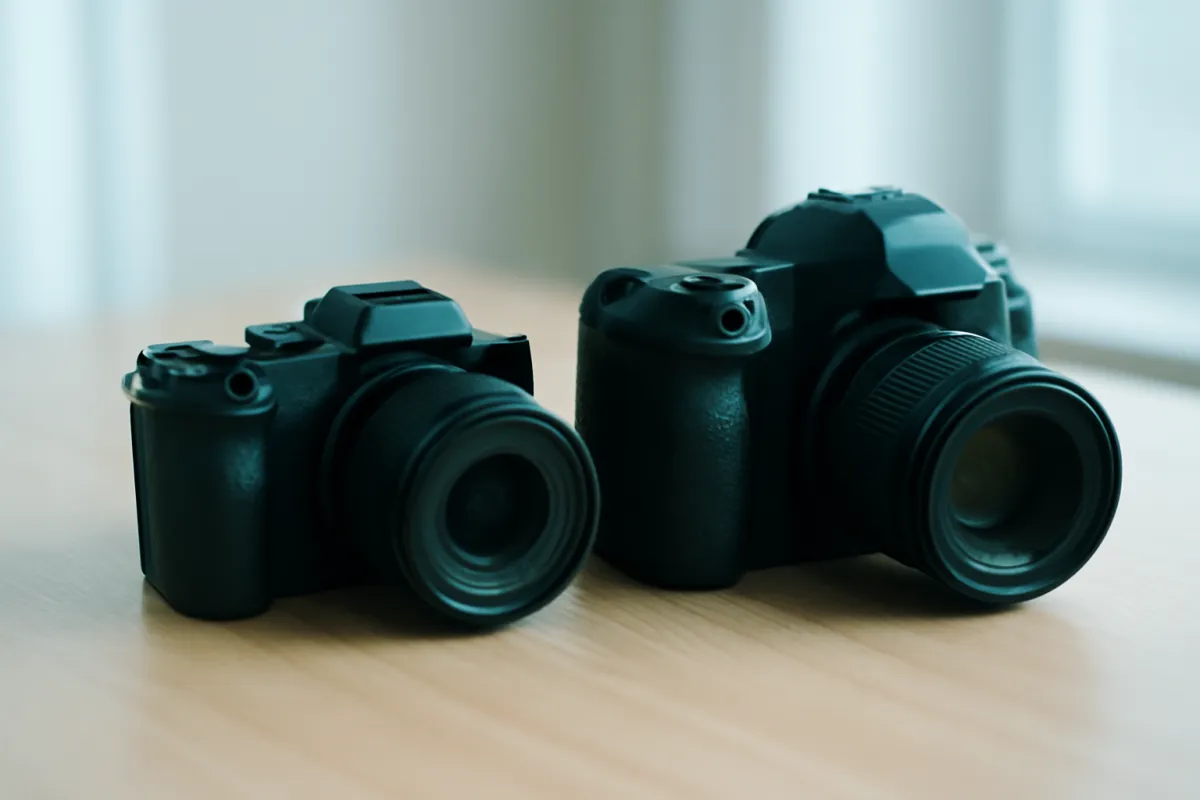
Strip away the marketing and only one physical thing separates these two cameras: the mirror. A DSLR (digital single-lens reflex) has a mirror sitting at an angle behind the lens that bounces the incoming light up into a prism and out through an optical viewfinder, so when you raise the camera to your eye you are looking at the real scene through glass. The instant you press the shutter, that mirror flaps up out of the light path, the sensor records the frame, and the mirror drops back down. That flap is the clatter a DSLR makes.
A mirrorless camera does exactly what the name says: it deletes the mirror. Light from the lens falls directly and continuously onto the sensor, and you frame either on the rear screen or through a small electronic viewfinder, a tiny high-resolution display showing the sensor’s live feed. Everything else in this comparison, the size, the autofocus behavior, the video strength, the battery drain, the finder experience, cascades from that one design choice. Once you see that the whole argument is downstream of a single question, is there a mirror in the box, the rest of the decision gets much easier to reason about. The mirror was a brilliant solution to a problem that modern sensors and screens have since solved a different way.
The electronic viewfinder advantage
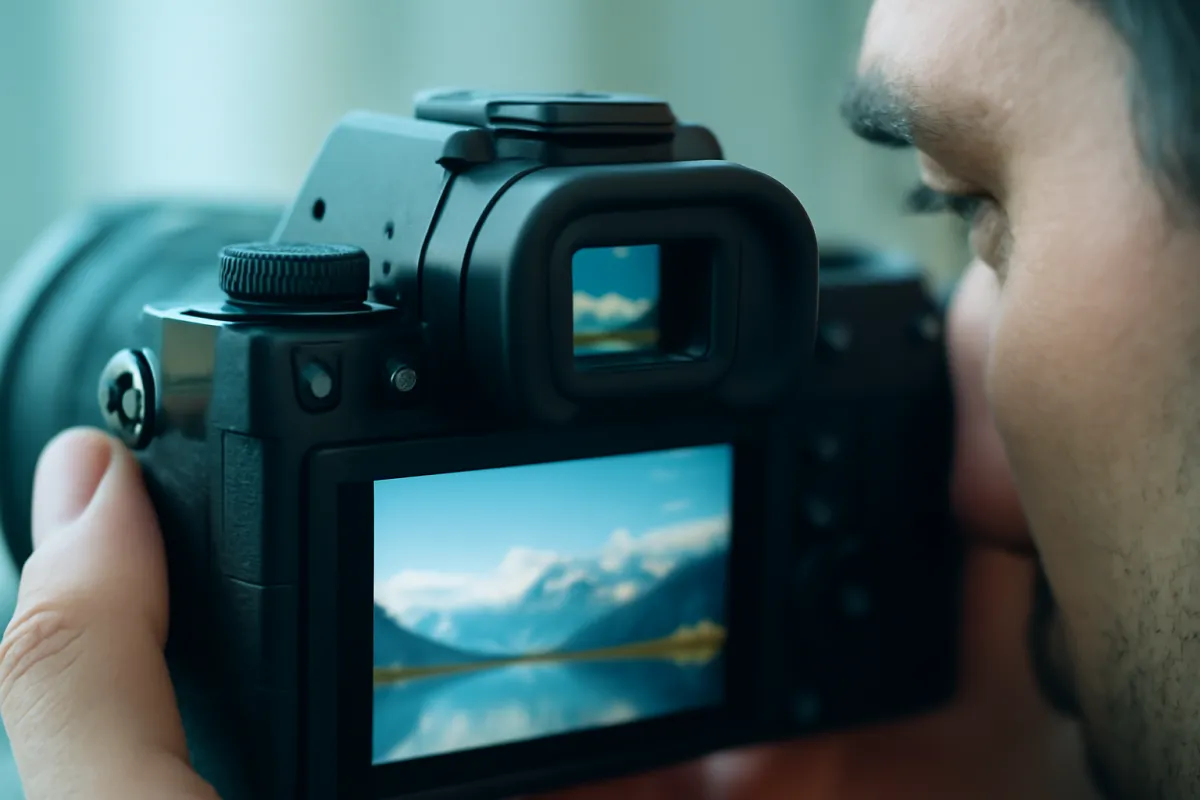
The single feature that has flipped more buyers than any other is the electronic viewfinder, and it is worth understanding why. Because a mirrorless finder shows the sensor’s live feed rather than raw light through glass, it can show you the actual photograph before you take it. Brighten the exposure and the finder brightens; shift the white balance and it shifts; apply a picture style and you see it. This is what-you-see-is-what-you-get shooting, and for anyone still learning the relationship between shutter, aperture, and ISO, it collapses the guesswork that a DSLR leaves to trial and error on the rear screen after the fact.
The advantages keep going. An electronic finder can overlay a live histogram, focus peaking that outlines what is sharp, a magnified view for precise manual focus, and a level, all inside the frame while you compose. It can gain up in near-darkness to show you a scene your eye can barely see. The classic knock, that early electronic finders lagged and looked coarse, has largely dissolved: current finders are bright, high-resolution, and fast enough that most shooters stop noticing they are electronic within a day. The one situation where the optical finder still feels better is fast action in bright light, where some shooters prefer the zero-lag, zero-processing view of real glass, a preference we take seriously later in this article.
Autofocus, where mirrorless pulled ahead
Autofocus used to be the DSLR’s home turf, and it is now where mirrorless has opened the clearest lead for most shooting. The reason is architectural. A DSLR focuses using a separate, dedicated autofocus sensor fed by the mirror, which is fast and dependable but works from a fixed grid of focus points clustered near the center of the frame, and it cannot actually see your subject the way the imaging sensor can. A mirrorless camera focuses using the imaging sensor itself, which means it analyzes the entire frame and runs subject-detection: it finds and locks onto eyes, faces, animals, birds, and vehicles, then tracks them wherever they move.
For portraits this is transformative, because the camera nails focus on the near eye automatically while you concentrate on expression and light. For wildlife and sports it means the camera holds a subject across the frame instead of losing it the moment it leaves the center cluster. The honest qualifier is that flagship DSLRs still autofocus superbly for many kinds of action through the optical finder, and a skilled shooter is not helpless with one. But the floor has risen dramatically on mirrorless: shots that once demanded real technique now come sharp from a beginner, because the machine is doing the hard part. If you have chosen autofocus as your priority in the companion above, that choice alone tilts the recommendation, for exactly this reason.
The scorecard: where each system wins
It helps to see the categories side by side rather than argued one at a time, because the pattern is lopsided in a way that a list of paragraphs can hide. Score each capability by how far ahead the mirrorless system sits today, and the shape of the decision appears at a glance. The one bar that runs short is the one that matters to the DSLR’s remaining fans.
Where mirrorless leads, and where the DSLR holds on
Rough lead score for mirrorless by category, 0 to 10. Higher means a wider mirrorless advantage. Illustrative.
Each width is the score over ten. Four categories run long for mirrorless; battery is the lone short bar, where the DSLR still wins. That is the whole argument in one picture.
Read the chart as a summary, not a verdict, because the short bar can outweigh the long ones for the right buyer. A photographer who spends long days far from a power outlet may value that single battery category more than all four mirrorless advantages combined, which is precisely why the decision is personal rather than universal. The scorecard tells you the direction of the wind; your own shooting tells you whether to sail with it. Tally the rows against your priorities and the companion above will name where your case lands.
Size and weight
Delete the mirror and prism and you delete a box of glass and metal from the middle of the camera, so mirrorless bodies started life smaller and lighter than DSLRs, and for many buyers that is reason enough. A smaller body is a body that actually comes along, which as our full-frame versus crop field note argues is the single biggest predictor of whether a camera takes any photos at all. For travel, street, hiking, and everyday carry, the size difference is not a spec-sheet nicety; it is the difference between a camera in the bag and a camera on the shelf.
Two honest qualifiers keep this from being a rout. First, the body is only part of the system, and lenses do not shrink as much as bodies do: a fast full-frame lens is a substantial object on either mount, so a mirrorless kit with serious glass is lighter than the DSLR equivalent but not pocketable. Second, some photographers actively want a larger body, because bigger cameras balance big lenses better and give clubs-for-hands more to hold onto, which is why several mirrorless makers now offer chunkier bodies and add-on grips. The net remains a real mirrorless advantage in portability, just a smaller one than the bare-body photos suggest. Weigh it by your own carry habits, not by the marketing silhouette.
The lens mount question is the real lock-in
Here is the decision hiding under the whole debate, and the one most buyers underrate: you are not really choosing a camera body, you are choosing a lens mount, and the mount is where the money and the years go. A camera body is a computer with a shutter that you will replace in a handful of years. The lenses you buy for its mount can outlast three or four bodies, and switching mounts later means selling your glass at a used-market loss and rebuying at retail. The body is the cheap, temporary part; the mount is the long, expensive commitment.
This is exactly why the industry’s move to mirrorless matters so much to a 2026 buyer. When you buy into a mirrorless mount, you are buying into the ecosystem where every maker is actively releasing new lenses, where the optical designs are current, and where the selection grows every year. When you buy into a DSLR mount new, you are buying into a lens catalog that is essentially complete and no longer growing, superb but frozen. Neither is wrong, but they are different bets: one on a system still being built, one on a system already finished and now discounted. Budget for the glass, not just the body, and price the whole mount before you commit, because that is the purchase you are actually making. The companion above sizes your lens fund as you read.
Battery life, the DSLR’s remaining edge
Give the DSLR its due, because on battery life it wins cleanly and it is not close. A DSLR can be composed entirely through its optical finder, which is just glass and a mirror and draws almost no power, so the camera sips battery while you frame and only spends real energy at the moment of exposure. A single charge on a DSLR commonly outlasts a mirrorless body by a wide margin, sometimes shooting well over a thousand frames where a mirrorless camera taps out far sooner. This is the physical cost of the electronic finder and the always-live sensor: they are wonderful, and they are hungry.
How much this matters depends entirely on how you shoot. For most people it is a minor inconvenience solved by an inexpensive spare battery or two tucked in the bag, and modern mirrorless bodies have improved their endurance considerably. But for specific shooters the DSLR edge is genuine and practical: photographers on multi-day backcountry trips far from any outlet, event and wedding shooters working long days who hate swapping batteries mid-moment, and anyone shooting in deep cold where batteries fade fast. If you chose battery life as your priority in the companion above, it can tip a close call, and this is the one category where the honest answer sometimes reads DSLR.
Price and the used-DSLR value play
Now the argument that keeps the DSLR genuinely alive in 2026, and it is about money, not megapixels. Because the industry moved on, the used market is flooded with excellent DSLR bodies and lenses selling for a fraction of what they cost new, while the people who owned them upgraded to mirrorless. That glut is a gift to any buyer whose first constraint is budget. A used DSLR kit can deliver capability that would cost two or three times as much in new mirrorless, and every dollar saved on the body is a dollar that can go to the lens, which as our first-camera budget field note argues is where the money should lean anyway. If you already own a body and are eyeing this switch as your next purchase, our field note on whether a new camera is really the fix helps you test that before any money moves.
This is the value play, and it is a smart one for the right buyer. The tight-budget beginner, the student, the second-shooter needing a cheap backup, and the hobbyist who refuses to spend big can all get a tremendous amount of camera by shopping the depreciated DSLR market rather than the premium mirrorless one. The trade is honest: you are buying into a mature system rather than a growing one, and you accept older autofocus and weaker video in exchange for paying far less. For a buyer whose photography does not need cutting-edge tracking or serious video, that trade is often the sharpest use of the money in the whole hobby. Price both routes in the upgrade budget planner before deciding.
Adapting old DSLR lenses to mirrorless
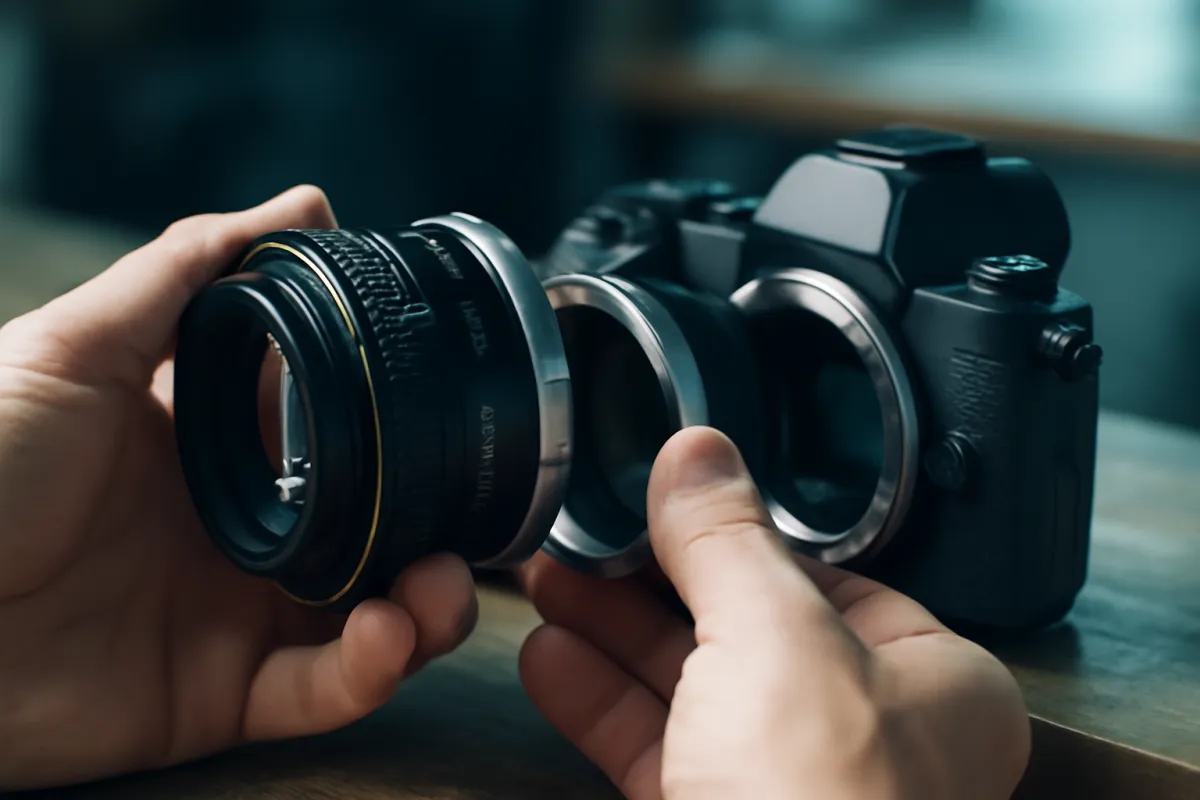
One fear stops more people from switching than any other: what happens to the lenses I already own? For most buyers the answer is reassuring. Camera makers sell adapters that mount their older DSLR lenses onto their newer mirrorless bodies, and because a good adapter maintains full electronic contact, autofocus, aperture control, and stabilization typically keep working. In many cases the adapted lens actually focuses better on the mirrorless body than it did on the DSLR, because the sensor-based autofocus is analyzing the whole frame. This turns the dreaded switch from a full system rebuy into a bridge you can cross gradually, carrying your glass with you.
The caveats are worth knowing so you are not surprised. First-party adapters (the maker’s own, matched to its lenses) are far more reliable than cheap third-party ones, which can be hit or miss on autofocus and firmware. A few older or slower lenses focus sluggishly when adapted, so the experience is best with recent, fast-focusing glass. The adapter also adds a little length and weight, nudging the mirrorless size advantage back toward the DSLR. And adapting is a bridge, not a destination: the whole point of buying into mirrorless is the native lenses, so most people adapt their old favorites while they gradually replace them with lenses built for the new mount. Used well, adapting removes most of the pain from the transition, which is exactly why so many DSLR owners have already made it.
Video: mirrorless dominates
If video is any part of your plan, the decision is effectively already made, because mirrorless dominates this category so thoroughly that serious video buyers rarely even consider a DSLR. The root cause is the same architecture that helps stills autofocus: a mirrorless camera reads its image straight off the sensor, so continuous autofocus during recording is smooth, confident, and able to track a subject as it moves, while a DSLR’s fast phase-detection focus is tied to the mirror being down and largely unavailable in video mode. That one difference makes run-and-gun and solo video vastly easier on mirrorless.
The advantage compounds from there. Mirrorless is where camera makers have put their best video features: higher frame rates for slow motion, better codecs and color options for editing, stronger in-body stabilization for handheld footage, and fewer of the recording-time and overheating limits that hampered video-capable DSLRs. The electronic finder and fully articulating screens common on mirrorless bodies also make composing video far more comfortable. A DSLR can shoot perfectly usable video in good conditions with careful manual focus, and plenty of beautiful footage exists to prove it, but as a tool for the way most people actually shoot video today, it is outclassed. Choose “mostly video” or “both” in the companion above and the recommendation swings hard toward mirrorless for exactly these reasons.
The viewfinder preference: optical purists
Not every advantage lives on a spec sheet, and the optical viewfinder has a devoted following for reasons that are real even if they do not photograph well as numbers. Looking through a DSLR is looking through glass at the actual world, with zero lag, zero processing, and infinite resolution, because it is not a display at all. Some photographers find that direct, analog connection to the scene calmer and more immersive than any electronic finder, and in very fast action under bright light, the lag-free optical view genuinely helps some shooters time a moving subject. This is a legitimate preference, not nostalgia to be argued away.
The counterpoint is that the electronic finder trades that purity for information, and for most photographers the trade is worth it: seeing the actual exposure, the histogram, the focus confirmation, and a preview of the final image tends to produce more keepers than the prettier but blinder optical view. The best way to settle this one is not to read about it but to hold both, raise each to your eye, and notice which one you enjoy looking through, because enjoyment is a real variable in whether a camera gets used. If the optical finder is the reason you love photography, that is a valid reason to choose or keep a DSLR, and no amount of feature list should talk you out of the tool you actually want to pick up.
Durability and weather sealing
Buyers often assume the older, chunkier DSLR must be the tougher camera, and the truth is more even than that instinct suggests. Both formats span the range from lightly built entry bodies to heavily weather-sealed professional ones, and durability tracks the tier and price far more than it tracks the presence of a mirror. A high-end mirrorless body is sealed against dust and moisture just as seriously as a high-end DSLR, and both will shrug off conditions that would worry an entry model of either type. There is no rule that mirror equals rugged.
There is one narrow, real difference worth naming. Because a mirrorless camera has no mirror covering the sensor, the sensor sits more exposed when you change lenses, which can let dust land on it more readily, and many bodies now add a curtain that closes over the sensor at power-off to address exactly this. A DSLR’s mirror, by contrast, shields the sensor during lens swaps but is itself a moving mechanical part that can, over a very long life, wear or misalign. Neither concern should drive a purchase for a normal user: sensor dust is a routine cleaning task on both, and mechanical wear takes an enormous shutter count to matter. Buy the sealing tier your conditions demand, on either format, and treat durability as a tier question rather than a format one.
Why the industry moved to mirrorless
It is worth understanding why every major camera maker pivoted, because the reason is also the strongest argument for a new buyer to follow them. Removing the mirror was not a gimmick; it unlocked genuine engineering freedom. Without a mirror box dictating the distance from lens to sensor, designers can build lenses with new optical formulas that are sharper, faster, or smaller than the DSLR mount allowed. Without a separate autofocus sensor, focus can use the whole imaging sensor and its computing power, which is what enabled subject detection. The mirrorless design is simply a more capable platform, and the makers went where the capability was.
For a buyer, the practical consequence outweighs the engineering story: research and development, new lenses, and new bodies now flow almost entirely to mirrorless. DSLR lineups have effectively stopped growing, receiving few or no new models, while mirrorless mounts get a steady stream of fresh glass and improved bodies every year. This does not make a DSLR stop working; a good camera takes good photographs for a decade regardless of what the market does. But it does mean a new DSLR purchase is a bet on a finished system, while a mirrorless purchase is a stake in a growing one. For most people starting fresh, buying into the direction of travel rather than against it is simply the lower-regret choice.
The interchangeable lens compact camera, explained
Shop for a camera and you will meet a phrase that never appears on any box: interchangeable lens compact camera. It is a category label rather than a product name, and it describes exactly what a lot of buyers are actually looking for, a camera small enough to carry like a point-and-shoot but able to swap lenses like a serious body. For years the industry called this a compact system camera, and in 2026 the category has one straightforward answer: mirrorless. Understanding the term is useful mainly because it explains what you are choosing between, and it dissolves a false three-way choice into a simple one.
Line up the options and the logic is quick. A fixed-lens compact is genuinely pocketable but you are stuck with the lens it was born with, so its reach and its low-light ability are capped forever, a trade our point-and-shoot field note covers in full. A DSLR takes any lens you like, but the mirror box and prism set a floor under how small the body can be, so compact is precisely what a DSLR cannot be. Remove the mirror and that floor disappears. That is why a compact interchangeable lens camera is, in practice, a mirrorless body: the missing mirror is the very thing that lets the camera shrink while keeping the lens mount, and it is why the phrase and the technology have effectively merged.
Size still depends on which mirrorless you pick, and this is where the category gets misread. Sensor size sets much of the bulk, so a Micro Four Thirds body with a small prime is the closest thing to a truly pocketable interchangeable lens compact camera, APS-C sits in the useful middle, and a full-frame mirrorless body with a fast zoom is compact only compared with a DSLR, not compared with anything you would call a compact camera. Our Micro Four Thirds field note explains that trade, and the honest rule is that the lens, not the body, usually decides whether the kit actually comes with you. A small body wearing a large zoom is a large camera.
So if what you want is an interchangeable lens compact camera, the practical shopping list is short: choose a mirrorless body, lean toward the smaller sensor formats if carrying it every day matters more than ultimate low-light performance, and pair it with one compact prime or a modest kit zoom rather than the biggest lens the mount offers. Everything else in this field note, the finder, the autofocus, the battery trade, and above all the mount lock-in, applies unchanged, because you are still choosing a mirrorless system. The category name simply describes the size you want the result to be.
Where sensor size fits the decision
A frequent tangle worth straightening: mirrorless versus DSLR is a body-type question, and full frame versus crop is a sensor-size question, and they are separate axes that buyers constantly mash together. Both mirrorless and DSLR systems come in full-frame and crop-sensor versions, so you are really making two decisions, not one. The body type decides your finder, autofocus, video, size, and which lens ecosystem you join; the sensor size decides light gathering, depth-of-field behavior, reach, and a large chunk of the system’s cost and weight. Deciding them independently keeps the reasoning clean.
Our full-frame versus crop field note handles the sensor axis in full, and its logic applies inside either body type. For most buyers the sensible path is to pick the body type first (mirrorless for nearly everyone buying new, per this article) and then choose the sensor size within it by matching your subjects and budget, with crop being the smart, lighter, cheaper starting point for the majority. The two decisions interact only at the wallet: a full-frame mirrorless system is the most expensive corner of the grid, and a crop DSLR bought used is the cheapest, which is why the value-first buyer and the future-first buyer often end up in opposite corners for entirely rational reasons. Roughly the same share of your budget is glass either way, so let the mount and the sensor each be decided on their own merits.
Who should still buy a DSLR
Pull the exceptions together into a clear profile, because the DSLR is not dead, it is specialized, and matching yourself to the profile is the whole test. Buy or keep a DSLR if you are budget-constrained and can exploit the flooded used market to get more camera per dollar than new mirrorless allows. Buy or keep a DSLR if you already own a meaningful set of its lenses and would rather not rebuy or adapt them. Buy or keep a DSLR if you genuinely prefer the optical finder and shoot the kind of stills, landscapes, portraits, general photography, where the mirrorless advantages in autofocus and video do not change your results much.
Notice what unites the profile: each case names a specific reason that outweighs the general trend, whether it is money already spent, money you want to save, or a preference you actually feel. What does not belong on the list is buying a DSLR new, at full price, with no existing glass, because you heard they are tougher or the finder is purer, when a mirrorless body would serve you better and hold its relevance longer. The DSLR buyer who ends up happy can finish the sentence “I chose a DSLR because,” with money, glass, or a real preference. The one who ends up regretful finishes it with “because it seemed safer,” which the market has quietly made untrue. If your reason is genuine, the companion above will read your case as DSLR, and this article endorses it.
Your first-year camera budget
Whichever body type you choose, the money splits the same way across your first year, and getting that split right matters more than the mirrorless-versus-DSLR choice itself. The instinct is to pour the budget into the body, but the body is the part you will replace first, and the lens is the part that shapes every photograph and outlasts several bodies. A sensible first-year plan leans toward glass, keeps the body modest, and never zeroes out the accessories that quietly keep shoots alive.
Your first-year camera budget, split three ways
A sensible starting division of a first-year total across the three buckets. Sums to 100 percent, illustrative.
The body takes the largest slice on a first system only because you are buying into a mount from scratch; once you own glass, later spending should tilt harder toward lenses. Note the spare battery living in the extras slice: on mirrorless it is not optional.
The split above is a starting point, not a law, and it moves with your choices. The used-DSLR value buyer can push the body slice down and the lens slice up, because a depreciated body costs less. The video shooter nudges a little back toward the body, where stabilization and codecs live. The one line that should never vanish is the extras slice, and on mirrorless it earns its place twice over, because that spare battery is the fix for the format’s one real weakness. Our first-camera budget field note walks this split in full, and the upgrade budget planner fills the three buckets with your own numbers.
The worked decision: three buyers, three answers
Abstract advice slides off; three concrete buyers make the logic stick, and each runs the same arithmetic to a different answer. Consider first a new hobbyist with no existing gear and a middling budget who wants to shoot family life and travel and dabble in video. Every arrow points mirrorless: the finder preview shortens her learning curve, subject detection keeps the kids sharp, the smaller body actually comes on the trip, and the video works when she wants it. She buys mirrorless without a second thought, and the only remaining question is crop versus full frame, which her budget answers as crop.
Now a tight-budget student who wants to learn real photography and shoots stills almost exclusively, portraits and landscapes, with no interest in video. The flooded used market makes a DSLR the sharpest use of his money: a depreciated body and a cheap fast prime deliver more image quality per dollar than new mirrorless can, and the older autofocus is plenty for deliberate stills. He buys a used DSLR and spends the savings on glass, exactly as the value play prescribes. Finally, a working event shooter who already owns a bag of DSLR lenses and shoots long days far from power weighs the switch and lands in the middle: she adopts a mirrorless body for its autofocus but adapts her existing lenses to bridge the cost, and keeps a DSLR as a backup for its battery life. Three buyers, three defensible answers, all from the same set of questions the companion above asks you.
Common mistakes in the mirrorless vs DSLR choice
The recurring ways this decision goes wrong, so you can skip them.
- Buying a DSLR new at full price with no existing glass. The used market is the DSLR’s whole argument; paying retail for one forfeits it and usually a mirrorless body would serve better.
- Fearing the lens switch more than it deserves. Most DSLR glass adapts to mirrorless with autofocus intact, so the transition is a bridge, not a teardown.
- Choosing the body and ignoring the mount. You are committing to a lens ecosystem for years; the body is the cheap, temporary part of that decision.
- Overrating battery life for casual use. A spare battery is a cheap fix for all but the most demanding, off-grid shooting.
- Letting the optical-versus-electronic finder debate become tribal. Hold both, notice which you enjoy, and let that honest preference count without pretending it settles the whole comparison.
- Confusing body type with sensor size. Mirrorless versus DSLR and full frame versus crop are two separate decisions; deciding them together muddles both.
Each mistake is the same error wearing different clothes: treating the camera body as the decision when the mount, the money, and your actual shooting are the decision. Get those three right and the mirrorless-versus-DSLR label mostly sorts itself, because the honest answer falls out of your budget, your glass, and what you point the camera at.
How to decide from your own shooting
End the debate with evidence you already own rather than the forum’s. Ask four questions in order. Do you already own DSLR lenses worth keeping? If yes, the switch has a cost the adapter can soften, and a DSLR or a bridged mirrorless body both stay in play. Is your budget your hardest constraint? If yes, the used DSLR market is the sharpest dollar in the hobby, and it deserves a serious look before anything new. Do you shoot any video, or want to? If yes, mirrorless is close to mandatory, and the question is mostly closed.
The fourth question is the tiebreaker for everyone who reached it without a clear answer: raise both kinds of camera to your eye and notice which finder you enjoy looking through, because a camera you enjoy is a camera you use, and use is the only thing that makes any of this gear worth owning. For the large majority of buyers, working these four questions honestly lands on mirrorless, because most people have no glass to protect, want autofocus and video to be easy, and adapt to the electronic finder within a day. For a real minority, the answers land on a DSLR for reasons that are entirely their own, and this article is happy to send them there. Run your inputs through the companion above, price the plan in the upgrade budget planner, and let the answer be yours rather than the internet’s.
The bottom line
Mirrorless versus DSLR is a lopsided contest for anyone buying new in 2026, and an open one for a specific few. Delete the mirror and you gain a finder that previews the photograph, autofocus that finds the eye, a smaller body, far stronger video, and a lens mount the whole industry is actively building out; you give up some battery life and the pure optical view. For almost everyone starting fresh, that trade is easy, and the answer is mirrorless. For the buyer with a tight budget, a shelf of DSLR glass, or a genuine love of the optical finder, the mature and now heavily discounted DSLR world is still a smart, honest choice. Decide the mount before the body, lean your budget toward glass in the upgrade budget planner, and remember that the sensor question is separate and covered in our full-frame versus crop field note. Then stop reading comparisons and go take photographs, because both kinds of camera do that beautifully.
This field note is written to sharpen a camera decision, not to close a sale: nothing here is sponsored, and no brand or model is named on purpose. Every dollar figure, split, and score is an illustrative planning aid rather than a quote or a lab result, and real prices and specifications shift with brand, generation, and the fast-moving used market. Camera systems differ in which lenses, adapters, and features actually exist, so confirm what is available for the specific mount you are weighing before any money changes hands. The right answer here is the one that matches your budget, your existing glass, and the photographs you genuinely take, so weigh this article against your own shooting rather than any spec sheet, and when a purchase is close, hold both cameras before you choose.
Frequently asked questions
Should I buy a mirrorless camera or a DSLR in 2026?
For almost everyone buying new in 2026, a mirrorless camera is the better choice, and the reasons stack up: the electronic viewfinder previews your exposure before you shoot, subject-detection autofocus has pulled ahead, the bodies are smaller, video is far stronger, and every camera maker is putting its new lenses on mirrorless mounts. A DSLR still makes sense in specific cases, mainly a tight budget met by the excellent used market, a shelf of lenses you already own, or a genuine love of an optical finder. But if you are starting fresh with no glass to protect, buying into mirrorless puts your money where the whole industry is heading rather than where it is leaving.
What is the actual difference between mirrorless and DSLR?
A DSLR uses a mirror and a prism to bounce light from the lens up into an optical viewfinder, so you see the real scene through the glass, and the mirror flips up out of the way the instant you take the photo. A mirrorless camera removes that mirror entirely: light hits the sensor continuously, and you frame either on the rear screen or through a small electronic viewfinder that shows the sensor's live feed. That one change, no mirror, cascades into nearly every other difference in size, autofocus, video, and how the finder behaves. Everything else in the comparison flows from whether there is a mirror in the box or not.
Is a DSLR still worth buying in 2026?
It can be, but only for specific buyers rather than as a general recommendation. The strongest case is value: because the industry has moved on, used DSLR bodies and lenses sell for a fraction of their original price, so a tight budget buys far more capable gear secondhand in the DSLR world than new in mirrorless. A DSLR is also worth keeping if you already own a set of its lenses, or if you simply prefer looking through an optical finder at the real world. What a DSLR is not is future-proof: new lenses and new bodies are overwhelmingly mirrorless now, so a DSLR purchase in 2026 is a smart use of a mature, cheap system rather than an investment in a growing one.
Is mirrorless autofocus really better than a DSLR's?
For most kinds of shooting, yes, and the gap has widened rather than closed. Because a mirrorless camera focuses using the imaging sensor itself, it can analyze the whole frame and run subject-detection that finds and tracks eyes, faces, animals, and vehicles across the image. A DSLR focuses with a separate dedicated sensor that is fast and reliable but works from a limited grid of points and cannot see subjects the way the imaging sensor can. High-end DSLRs still autofocus superbly for action through the optical finder, so this is not a knockout in every situation, but for portraits, wildlife, and anything that moves unpredictably, mirrorless subject tracking has become the easier tool to get sharp results with.
Can I use my old DSLR lenses on a mirrorless camera?
Usually yes, with an adapter, and often very well. Most camera makers sell an adapter that mounts their older DSLR lenses onto their newer mirrorless bodies, and because it maintains electronic contact, autofocus and stabilization typically keep working, sometimes better than they did on the original DSLR. This makes switching to mirrorless far less painful than buyers fear, since a shelf of good glass can move across with you. The main caveats are that first-party adapters work more reliably than third-party ones, a few older lenses focus slowly when adapted, and the adapter adds a little length and weight. For most people, adapting is a genuine bridge rather than a compromise.
Does a DSLR have better battery life than mirrorless?
Yes, and it is the DSLR's clearest remaining advantage. A DSLR can be framed and composed through its optical viewfinder using almost no power, because the finder is just glass and a mirror, so a single charge commonly lasts far longer than a comparable mirrorless body. A mirrorless camera has to power its sensor and an electronic finder or screen the entire time it is switched on, which drains the battery faster. In practice most mirrorless shooters solve this with a spare battery or two, an inexpensive fix, but for long days far from power, multi-day trips, or event work, the DSLR's endurance is a real and practical edge worth weighing.
Is mirrorless or DSLR better for video?
Mirrorless is clearly better for video, to the point that serious video buyers rarely consider a DSLR anymore. A mirrorless camera reads its image straight off the sensor, which makes continuous autofocus during recording smooth and reliable, and the format has become where makers put their best video features: higher frame rates, better codecs, stronger stabilization, and fewer recording limits. A DSLR can shoot video, but its autofocus in video mode is generally weaker because the phase-detection system that makes it fast for stills is tied to the mirror being down. If video is any real part of what you plan to do, the decision is effectively made for you.
Is mirrorless or DSLR better for beginners?
For a beginner starting fresh in 2026, mirrorless is usually the better path, and the reasons are practical rather than about prestige. The electronic viewfinder shows a brighter, live preview of your exposure, which shortens the learning curve because you see the effect of your settings before you press the shutter. Subject-detection autofocus makes sharp photos easier while you are still learning to focus deliberately, and the smaller bodies are more likely to actually come along. The one strong reason a beginner might choose a DSLR is money: a used DSLR kit can cost far less for similar capability, which frees budget for the lens that, as our field note on first-camera budgets argues, matters more than the body anyway.
What is an interchangeable lens compact camera?
An interchangeable lens compact camera is a category description rather than a product name: a camera small enough to carry like a point-and-shoot that still lets you swap lenses like a serious body. The industry once called these compact system cameras, and today the category is simply mirrorless, because removing the mirror and prism is exactly what allows a body to shrink while keeping a lens mount. A fixed-lens compact is smaller still but locks you into the lens it came with, and a DSLR takes any lens but cannot be genuinely compact, since the mirror box sets a floor under its depth. So the term describes the result you want, and mirrorless is the technology that delivers it. Which mirrorless you pick then decides how compact the result really is.
Which compact interchangeable lens camera should I buy?
Start by accepting that a compact interchangeable lens camera means a mirrorless body, then let sensor size and lens choice decide how small the kit actually ends up. Micro Four Thirds gives the closest thing to a truly pocketable system, APS-C sits in a useful middle ground of size, cost, and low-light ability, and full-frame mirrorless is compact only next to a DSLR rather than next to anything you would call a compact camera. The lens matters at least as much as the body, because a small body wearing a large zoom is a large camera, so pair it with one compact prime or a modest kit zoom if carrying it daily is the point. Everything else in this comparison, the electronic finder, the autofocus, the battery trade, and the mount lock-in, still applies, since you are choosing a mirrorless system either way.